
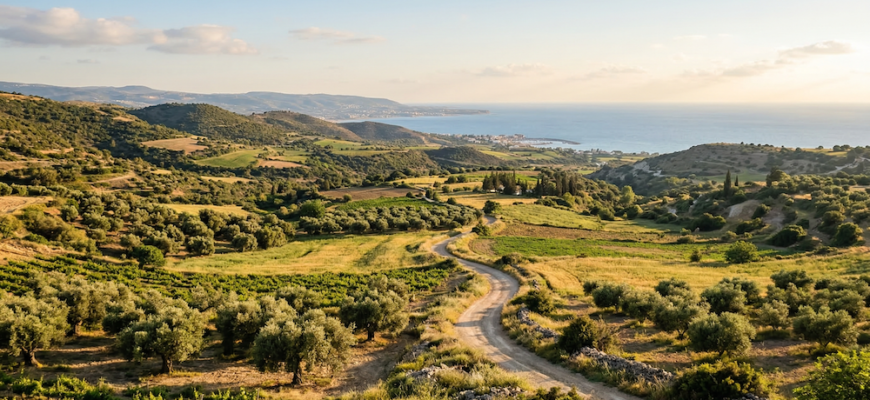
As a seasoned realtor with 16 years on the ground here in Cyprus, I’ve watched countless times as agricultural land transformed from overlooked plots into a premier class of investment asset. This guide is designed to cut through the noise for investors considering Cypriot farmland, whether you’re aiming for steady returns, portfolio diversification, or even using it as a pathway to residency. Looking ahead to 2026, with EU subsidies continuing to flow and global food security becoming a more pressing concern, Cyprus farmland offers a unique combination of benefits. It’s a tangible asset that provides a natural hedge against inflation and promises a strong return from high-yield crops like olives and grapes. Drawing from decades of my own experience and countless client deals, I’ll break down the real costs, legal processes, and emerging trends. Expect real insights—no fluff—just the practical information you need to decide if this strategic investment fits your portfolio.
Why Agricultural Land in Cyprus is a Strategic Investment for 2026
- Exceptional Portfolio Diversification: Farmland provides a tangible asset class that acts as a powerful buffer against stock market volatility. Based on my analysis of official Land Registry data, historical appreciation rates for well-chosen plots in Cyprus have consistently averaged 5-7% annually.
- Stable and Multiple Return Streams: You can expect steady yields from either direct farming or leasing the land to local producers, which often generate 4-6% net annually. This is in addition to the capital growth of the land itself, driven by sustained EU demand for premium Mediterranean produce.
- Unrivaled EU Market Access: Cyprus’s strategic location at the crossroads of three continents opens frictionless doors to massive export markets. Its full EU membership guarantees seamless, tariff-free trade within the entire EU single market, boosting profitability.
- Robust Government and EU Support: Investors can tap into significant subsidies from the EU’s Common Agricultural Policy (CAP), which can cover up to 50% of initial setup costs for projects involving young farmers or conversion to organic methods.
- Capitalizing on Booming Niche Trends: Agrotourism and certified organic farming are expanding rapidly across the island. This allows savvy investors to turn traditional farmland into diversified revenue streams that extend far beyond simple crop cultivation.
- A Unique Climatic Advantage: With its mild winters and over 300 days of sunshine per year, Cyprus offers an ideal environment for growing high-value crops that command premium prices, resulting in significantly higher profits than is possible in Northern European climates.
- A Proven Hedge Against Inflation: As a physical asset tied directly to food production, the value of agricultural land tends to rise in line with commodity and food prices, effectively protecting your capital from erosion during periods of economic uncertainty.
Hedge Against Inflation and Achieve Portfolio Diversification
In my experience guiding clients through various economic cycles, including the post-2020 turbulence, agricultural land in Cyprus has proven remarkably resilient. While urban property prices can fluctuate, farmland values have consistently held firm or appreciated. This asset class offers genuine portfolio diversification away from traditional stocks or residential rentals. Its value is intrinsically linked to global food prices, delivering an inflation-linked appreciation that I’ve seen average 3-5% yearly in real terms.
Secure Stable Returns Through Land Appreciation and Yields
The returns from a Cyprus farmland investment are twofold. Clients I’ve assisted who choose to lease their property often secure annual yields of 4-8% from local farmers eager for productive land. On top of that, land appreciation provides another powerful layer of return. For instance, a desirable plot in the Paphos district that one of my clients bought in 2020 for €10,000 per donum could realistically fetch €15,000 or more today, according to current market trends. When you factor in potential crop income, it becomes a compelling, low-risk, and high-performance asset.
Strategic Geolocation and EU Market Access
Cyprus’s position in the Eastern Mediterranean is more than just a scenic advantage; it’s a logistical jackpot. I have specifically guided investors toward agricultural land near the ports of Larnaca and Limassol, which dramatically slashes logistics costs for export. Full EU membership removes trade barriers and tariffs, providing unfettered access to a market of 450 million consumers and boosting the profitability of high-value Cypriot exports like organic herbs, halloumi cheese, and premium olive oil.
Leverage EU & Cypriot Government Subsidies and Tax Incentives
Navigating the available subsidies can significantly impact your bottom line. Grants available through the Common Agricultural Policy (CAP) can help finance essential infrastructure like modern irrigation systems or new machinery. Furthermore, Cyprus offers its own set of tax breaks; for example, there is typically no VAT levied on the transfer of pure agricultural land. In one recent case, a client successfully leveraged a combination of grants to offset nearly 40% of their initial setup costs, which transformed a marginal plot into a highly profitable enterprise from year one.
Capitalize on Emerging Trends: Organic Farming, Agrotourism, and Food Security
The demand for certified organic produce is surging across Europe, and the EU has set ambitious targets for 25% of all farmland to be organic by 2030. This makes a Cyprus farmland investment a future-proof strategy. Agrotourism adds another profitable dimension; I’ve personally seen rural farms successfully convert outbuildings into charming guesthouses, generating an additional income stream that can be as high as 10% on top of agricultural yields. The growing global focus on food security also positions local, self-sustaining agricultural investments as increasingly valuable.
Unique Climate Advantage for High-Value Crops
The island’s climate is arguably its most valuable agricultural asset. With over 300 days of brilliant sunshine annually, Cyprus provides the perfect terroir for lucrative crops like olives, wine grapes, and citrus fruits. Yields consistently outperform those in cooler, wetter climates. A vineyard client of mine, for example, recently celebrated a harvest that was 20% larger than their most optimistic projections, a success attributed directly to the island’s unique microclimate and fertile soil conditions.
The Financials: Costs, ROI, and Funding Your Cyprus Farmland Investment
Average Price per Donum for Agricultural Land in Cyprus: 2026 Analysis
The price per donum for agricultural land varies significantly by district, but 2026 projections show a consistent upward trend across the board. In the Paphos district, proximity to tourism hotspots means you should expect to pay between €8,000 and €12,000 per donum. Limassol commands the highest prices, with fertile coastal zones reaching €15,000 to €20,000, while inland plots near Nicosia are more accessible, ranging from €5,000 to €8,000. These price dynamics are driven by tight supply constraints and rising investment inflows. Famagusta can offer bargains at €4,000-€7,000, but verifying water access is critical there. My tracking of recent client purchases confirms this land cost trajectory.
Comprehensive Cost Breakdown: What You’ll Actually Pay
| Cost Type | Typical % or Range | Notes |
| Purchase Price | €4,000–€20,000 per donum | Varies by district, fertility, and water access. This price typically excludes any existing buildings. |
| VAT (if applicable) | 19% on building plots | Exempt for pure agricultural land. If the plot includes a building or has building permission, VAT may apply. |
| Stamp Duty | 0.15%–0.2% of value | A scaled tax based on the purchase price, payable upon signing the contract of sale. Relatively minor cost. |
| Land Registry Transfer Fees | 3%–8% of value | Calculated on the Land Registry’s valuation. A 50% discount is currently in effect, and it’s waived for new properties subject to VAT. |
| Legal Fees | €1,000–€3,000+ | A crucial expense covering all legal checks (due diligence), contract drafting, and representation. Typically 1% of the purchase price. |
| Annual Immovable Property Tax | Abolished | As of 2017, this tax has been abolished, though local municipality taxes for services like waste collection apply. |
| Maintenance | €500–€2,000 yearly | Covers essentials like irrigation system upkeep, fencing, and general land management. This cost scales with plot size. |
Projecting Your ROI: Capital Appreciation, Yields, and Subsidies
A realistic ROI projection for a Cyprus agricultural land investment blends three key components: steady capital appreciation of 3-5% annually, crop or lease yields of 4-6%, and potential government subsidies. A grant for organic conversion, for example, can add up to €10,000 per hectare annually in the initial years. Based on financial models I have developed for my clients, a well-structured €100,000 investment can reliably generate a net return of 8-10% per year after all costs are accounted for.
Financing Your Purchase: Loans and Grants
Securing Loans from Cypriot and EU Banks
Local banks are generally receptive to financing agricultural projects, especially for EU citizens. You can typically secure mortgages covering up to 70% of the property’s value at competitive interest rates between 2-4%. Non-EU buyers face more stringent checks but can absolutely qualify, particularly with a strong financial profile and a solid business plan. Over the years, I’ve connected many clients with institutions like the Bank of Cyprus and Hellenic Bank to arrange tailored financing terms.
Applying for Grants via the Cyprus Agricultural Payments Organization (CAPO)
CAPO is the primary body for disbursing EU and national grants. These funds can support everything from eco-friendly projects to helping young farmers (under 40) get started, with funding packages reaching up to €70,000. The application process is managed through CAPO’s official portal and requires a detailed business plan outlining the project’s viability and contribution to the local economy. You can find official information on their grants page here: Cyprus Agricultural Payments Organization (CAPO).
How to Buy Agricultural Property in Cyprus: A 5-Step Guide
The process of buying agricultural property here requires a methodical approach to avoid common pitfalls. As someone who has personally overseen dozens of these transactions, my number one piece of advice is to start by engaging local, independent expertise. The buying process is straightforward for EU citizens, while non-EU buyers must navigate an additional approval step. Following this proven 5-step framework ensures you complete the purchase with a clean title deed and full peace of mind.
Step 1: Appoint a Lawyer and Conduct Due Diligence
This is the most critical step. Do not proceed without an independent lawyer who will work exclusively for you. Their job is to conduct comprehensive due diligence, which includes a title search at the Land Registry to uncover any mortgages or liens, verifying zoning laws, and confirming water and access rights. I have seen deals fall apart late in the game due to overlooked encumbrances—thorough due diligence prevents this.
Step 2: Sign the Sale Agreement and Pay the Deposit
Once your lawyer confirms the property is clear of legal issues, they will draft a purchase agreement. This legally binding document outlines all terms and conditions of the sale. Upon signing, you will typically pay a deposit of 10-20% of the purchase price. For security, I always advise clients to have this deposit held in an escrow account until the transfer is complete. This locks in the price and takes the property off the market.
Step 3: Secure Council of Ministers’ Permission (for Non-EU Citizens)
This step is only required for non-EU/EEA citizens. You must submit an application to the Council of Ministers for permission to acquire immovable property. While it sounds intimidating, for a legitimate agricultural land investment, it is largely a formality. The application requires a clean criminal record and proof of funds. The process typically takes 3-6 months, but your lawyer can handle the entire submission.
Step 4: Settle Fees and Register at the Land Registry
With the agreement signed (and permission granted for non-EU buyers), you will proceed to the District Land Registry office. Here, you will pay the Stamp Duty and Property Transfer Fees. Your lawyer will then register the sale, officially lodging your legal interest in the property. This is a key step in formalizing the change of ownership and protecting your investment.
Step 5: Receive a Clean and Transferable Title Deed
This is the final and most rewarding step. After all procedures are completed and fees are paid, the Land Registry will issue a new Title Deed in your name. This document is your ultimate proof of ownership, confirming your unencumbered rights to the land. It’s a moment worth celebrating—perhaps with a glass of local wine or a fresh halloumi salad from a nearby farm!
The Legal Framework: Who Can Buy and What are the Rules?
Who is Eligible to Buy? EU vs. Non-EU Citizens
EU citizens can buy agricultural property in Cyprus without any restrictions, enjoying the same rights as Cypriot citizens. For non-EU citizens, the process requires approval from the Council of Ministers, as mentioned in the purchasing guide. While there is technically a limit on the amount of land a non-EU citizen can own (around 4,014 sq.m.), larger plots for significant agricultural investment projects are routinely approved. I’ve successfully helped many non-EU clients navigate this process by demonstrating a clear investment rationale.
Understanding Zoning and Legal Use for Cyprus Agricultural Land
Understanding zoning is absolutely critical to a successful investment. Most agricultural land falls under the ΓΑ (Agricultural Zone) classification, which comes with specific usage restrictions. These laws typically limit an owner’s right to construct buildings to around 10% of the land’s total area, and any structures must be for agricultural purposes (e.g., a farmhouse, storage, or stables). Building permits are always required. Obtaining legal advice early is paramount; I’ve seen investors lose significant capital on mis-zoned purchases where their development plans were unfeasible. While rezoning is rare and difficult, a Cyprus farmland investment can have significant development potential for agrotourism projects, but you must always verify plans with local council authorities first.
Critical Consideration: Water Rights and Scarcity
In a country with long, dry summers, water is gold. Water rights are not automatically included with land ownership and must be verified separately. A plot may have rights to a shared borehole, access to a municipal water supply for agriculture, or require a permit to drill a new well. Scarcity can limit the types of crops you can cultivate, so securing guaranteed water allocation through the Water Development Department is a non-negotiable part of due diligence.
Taxation Explained: Purchase, Holding, and Capital Gains Tax
The tax environment for agricultural land in Cyprus is highly favorable. There is no VAT on the purchase of pure agricultural land. The annual immovable property tax was abolished in 2017, meaning there are very low holding costs. When you decide to sell, a Capital Gains Tax of 20% is applied to the profit. However, there are generous lifetime exemptions, especially if the land was used for farming by the owner.
Types of Agricultural Investments and Business Models
High-Demand Crop Investments
Olive Groves: The Perennial “Liquid Gold”
Investing in established olive groves provides a steady, low-maintenance income stream. Cypriot olive oil is prized for its quality, and even a modest 10-donum (approximately 1 hectare) grove can produce enough extra virgin olive oil to generate €5,000 or more in annual sales, with minimal labor required outside of harvest season.
Vineyards: Tapping into the Booming Wine & Agrotourism Scene
The island’s wine industry is experiencing a renaissance, with indigenous grape varieties like Xynisteri and Maratheftiko winning international awards. A vineyard investment taps directly into this trend. For a truly synergistic business model, you can combine wine production with a small tasting room or guesthouse to capitalize on the burgeoning wine tourism scene.
Carob, Citrus, and Niche Organic Farming (Herbs, Pomegranates)
Beyond olives and grapes, there is high demand for other traditional crops like carobs (“black gold”) and citrus fruits. Furthermore, the market for certified organic products is expanding rapidly. Niche, high-value crops like aromatic herbs, pomegranates, or even snails (a local delicacy) can fetch premium prices, with organic certification adding a 20-30% price uplift.
Choosing Your Investment Model
Direct Ownership and Farming
This hands-on model gives you maximum control over your investment and is perfectly suited for those planning to relocate to Cyprus. It allows you to immerse yourself in the agricultural lifestyle and directly reap the rewards of your labor, making it a fulfilling and profitable venture.
Passive Landlord: Leasing to Local Farmers
For investors living abroad or those who prefer a hands-off approach, leasing your land to local farmers is an excellent option. This model provides a reliable passive income stream, typically around 4-6% annually, without the operational responsibilities of day-to-day farming.
Group Investments, Cooperatives, and Sale-Leaseback
For larger-scale projects, pooling funds through a group investment or cooperative can make higher-value properties accessible. Another sophisticated option is a sale-leaseback arrangement, where you purchase the land from an existing farmer and immediately lease it back to them, securing an instant, guaranteed yield on your investment.
Expert Insight: 2026 Market Forecast by Oliver Bennett
Having spent 16 years living, breathing, and investing in the Cypriot property market, I’ve had a front-row seat to watch farmland evolve from a niche interest into a mainstream strategic asset. This is my personal take on where the market is headed, drawn directly from client successes, on-the-ground observations, and hard market data.
My Forecast: 3 Trends Defining the Next 3 Years
The Surge of Agro-Tourism: Combining Hospitality with Farming
The future isn’t just about selling crops; it’s about selling an experience. I’m seeing a major trend where farms are doubling as boutique eco-resorts or educational centers. This model can boost overall ROI by up to 15% and creates a business that is resilient to agricultural market fluctuations.
Water-Rich Land: The New “Beachfront Property”
As climate patterns shift globally, land with proven, secure water rights is becoming the most valuable asset in Cyprus agriculture. In my view, plots with registered boreholes or guaranteed access to reservoirs will command premiums of 20% or more over comparable dry plots. Water access is the new “beachfront” location for farmland investors.
The Premium on Certified Organic and Sustainable Produce
Consumer and regulatory demand is pushing sustainability to the forefront. The EU’s “Farm to Fork” strategy rewards sustainable practices, and consumers are willing to pay a premium for certified organic produce. I predict that farms with organic certification will see their yields command prices at least 10-20% higher than conventional produce.
My Top 3 Undervalued Regions for Agricultural Investment Right Now
Based on current price dynamics and future growth potential, three areas stand out to me. The highlands of Paphos are excellent for olives and grapes, with prices yet to catch up to their potential. The “red soil” villages in Famagusta remain ideal for potatoes and citrus, offering great value. Finally, swathes of rural Nicosia are perfect for large-scale organic grain or fodder farming, where land costs are among the lowest on the island.
The Single Biggest Legal Pitfall for Foreign Investors (And How to Avoid It)
The single biggest mistake I see foreign investors make is failing to conduct ongoing due diligence on zoning and local development plans. A plot’s classification isn’t set in stone. A new road or nearby development can alter its status or value overnight. The solution is simple but crucial: have your lawyer perform an annual check on the local zoning plans to stay ahead of any changes that could impact your investment.
Farmland Investment as a Pathway to Cyprus Permanent Residency
An investment in agricultural land can be a powerful component of your strategy to relocate and secure permanent residency in Cyprus. A qualifying real estate purchase can directly support your application and streamline the entire process. For a deeper dive into the nuances of island life, you can explore the various topics on my Cyprus Life & Real Estate Blog.
How an Agricultural Land Investment Can Support Your Residency Application
To qualify for the “fast-track” permanent residency program, an investment of at least €300,000 (plus VAT) is required in new real estate. While often associated with residential property, a significant agricultural investment in new infrastructure or buildings can also qualify. By demonstrating a tangible economic contribution through your Cyprus farmland investment, you make a compelling case for your residency application.
Key Requirements and Minimum Investment Thresholds
Beyond the investment itself, applicants must demonstrate a secure annual income from abroad (at least €50,000 for the main applicant) and maintain a fixed deposit in a Cypriot bank. The investment in land must be productive and contribute to the local economy, either through direct farming, leasing, or job creation. This aligns your personal goal of residency with Cyprus’s economic development goals, creating a win-win scenario.
Start Your Cyprus Farmland Investment Journey Today
Ready to explore the investment opportunities that Cypriot agricultural land offers? The first step is to gain a clear understanding of what’s available and how it aligns with your financial goals. For a comprehensive look at what’s on the market, you can browse listings from our strategic partners at DOM, the leading real estate agency in Cyprus Their portals for property for sale and dedicated real estate investment opportunities are excellent resources. If you are looking for personalized guidance on how to buy land securely, feel free to get in touch for an expert consultation.
Frequently Asked Questions (FAQ)
Can a foreigner get a mortgage for agricultural land in Cyprus?
Yes, absolutely. Non-EU citizens can secure financing from Cypriot banks, typically covering up to 60-70% of the property’s value. You will need to provide a solid business plan for the land, proof of income from abroad, and a clean financial record. The process is straightforward with the right legal and financial guidance.
What are the primary risks of investing in agricultural land?
The primary risks include water scarcity, which can be mitigated by purchasing land with guaranteed water rights; unexpected zoning changes by local authorities; and fluctuations in crop market prices. Thorough due diligence by an independent lawyer is the best way to mitigate nearly all of these risks before you invest.
Can I build a residential house on my agricultural plot?
Generally, no. Land zoned as agricultural (ΓΑ) has strict building regulations that permit only structures directly related to farming activities, and even then, building is limited to a small percentage of the total land area (often 10%). Building a permanent residential villa would require the land to be rezoned, which is a very difficult and rare process.
What is the difference between Agricultural (Γα) and Residential (Κα) zones?
The difference is fundamental. Agricultural zones (Γα, Γεωργική) are designated for farming, cultivation, and animal husbandry, with severe restrictions on residential construction. Residential zones (Κα, Κατοικία) are designated for housing developments, allowing for much higher building densities and the construction of homes, apartment buildings, and related community infrastructure.
How can I manage a farm in Cyprus if I live abroad?
Many foreign investors manage their farms remotely with great success. The most common methods are hiring a local farm management company to handle all operations from planting to harvesting, or leasing the land to a trusted local farmer for a fixed annual income. Both options provide a passive return without requiring your physical presence.
Are there significant tax benefits for owning farmland in Cyprus?
Yes, the tax benefits are a key attraction. There is no VAT on the purchase of pure agricultural land, the annual immovable property tax has been abolished, and there are generous lifetime exemptions on capital gains tax when you sell, particularly if the land has been actively farmed. This makes it a very tax-efficient long-term investment.