- The Core Decision: Public vs. Private Schools at a Glance
- Deep Dive: The Private & International School System
- Language of Instruction: Navigating English-Speaking Schools and Greek Language Integration
- Key Education Systems: British Curriculum vs. International Baccalaureate (IB) and More
- The British System: IGCSEs & A-Levels
- The International Baccalaureate (IB) Programme
- Other National Systems (American, Russian, French)
- Beyond Academics: A Guide to After-School Activities and Extracurriculars
- The Public School System: An Honest Look for Expat Families
- The Pros: True Cultural Immersion and Zero Tuition Fees
- The Cons: The Reality of the Language Barrier and System Differences
- Oliver’s Take: Who is the Public System REALLY For?
- 2026 Tuition Fees: Estimating the Annual Cost of Private Education
- The Hidden Costs Every Expat Parent Should Budget For
- Top-Ranked International Schools for 2026: A City-by-City Guide
- Limassol: The Cosmopolitan Hub
- The Heritage Private School: Overview, Fees & Location
- Foley’s School: Overview, Fees & Location
- Paphos: The Family-Friendly Choice
- The International School of Paphos (ISOP): Overview, Fees & Location
- Aspire Private British School: Overview, Fees & Location
- Nicosia & Larnaca: Capital and Coastal Options
- The English School, Nicosia: Overview, Fees & Location
- American Academy Larnaca: Overview, Fees & Location
- How to Enroll: A 2026 Admission Checklist for Cyprus Schools
- The Enrollment Timeline: When to Start for the 2026-2027 School Year
- Required Documents Checklist
- Oliver’s Pro Tips: Making the Right Choice for YOUR Child
- The 7 Critical Questions to Ask Yourself Before Choosing
- The “Third Option”: Are Greek Private Schools a Fit for Your Family?
- Find Your Family Home Near Cyprus’s Best Schools
- Frequently Asked Questions
When families plan a relocation to Cyprus for 2026, the school decision shapes everything—from where you’ll want to buy property in Cyprus to your family’s daily quality of life. I’ve seen it firsthand time and again: parents who select the right school see their families integrate faster, their children thrive socially and academically, and the entire move feels like a genuine success. On the flip side, a poor choice can mean being stuck in agonizing daily commutes across districts or dealing with persistent cultural or academic mismatches. As someone who has helped over 200 families settle on the island, I always tie school choices to real estate strategy. Securing a home near a top school not only simplifies logistics but also enhances your property’s value, boosting its resale potential by 15-20% in high-demand areas like Limassol. This decision is far more than just education; it’s the foundation for your family’s new life on the island.
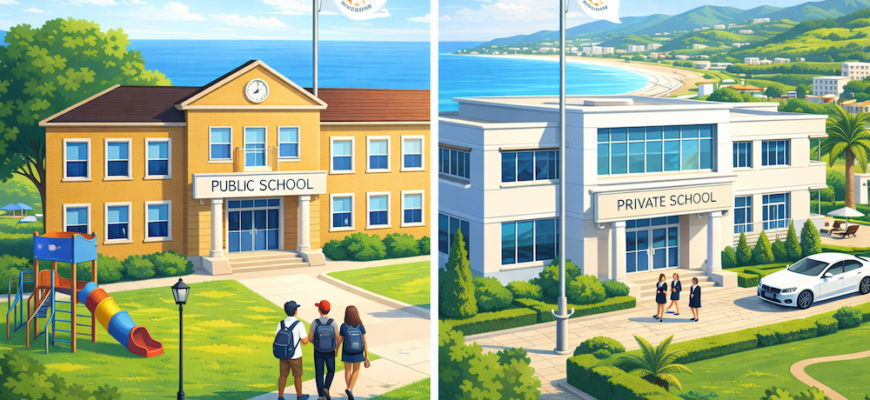
The Core Decision: Public vs. Private Schools at a Glance
To cut through the noise and provide immediate clarity, here’s a direct comparison of public and private schools in Cyprus. This overview is built from my experience advising relocating expat families, focusing squarely on what matters most when making your choice.
| Criterion | Public Schools | Private/International Schools |
| Annual Cost | Free (excluding minor fees for materials) | €5,000–€20,000+ per year, depending on level |
| Language of Instruction | Primarily Greek | Mostly English, with Russian, French, and other options available |
| Curriculum & University Pathways | Greek national curriculum (Apolytirion diploma), geared toward Cypriot and Greek universities | British curriculum (A-Levels), International Baccalaureate (IB program), or other international standards for global university access |
| Social Integration | Deep and rapid immersion in Cypriot culture and the Greek language | Diverse, international expat community; local integration is often slower |
| Class Size & Resources | Generally larger classes (20-30 students) with standard state-funded facilities | Smaller class sizes (10-20 students) with advanced resources, labs, and technology |
| Best For… | Families committed to long-term immersion, those with very young children, and those prioritizing budget savings | Expats prioritizing an English-speaking environment, seamless academic continuity, and internationally recognized qualifications |
Deep Dive: The Private & International School System
For the vast majority of expat families, private schools in Cyprus are the default choice, primarily because they offer familiar, English-speaking educational environments that significantly ease the transition. Based on my 16 years here, including placing my own children in these systems, they excel in preparing students for global opportunities. Looking ahead to 2026, the increasing number of relocations means demand for places is incredibly high—top-tier international schools Cyprus offers can see their spots fill up more than a year in advance. This guide breaks down what makes them the go-to option for families planning an education-focused move to the island.
Language of Instruction: Navigating English-Speaking Schools and Greek Language Integration
Most private English-speaking schools in Cyprus conduct all core subjects in English, which removes a significant immediate hurdle for expat children. From my personal experience, this allows children to settle in and focus on their academic progress without the initial stress of a language barrier. However, it’s a common misconception that students won’t learn Greek. In fact, many schools integrate mandatory Greek language lessons into their weekly schedule, as required by the Ministry of Education. Bilingual programs might offer 2-4 hours of formal Greek instruction per week, equipping children with the conversational skills needed to connect with the local community, which is invaluable for long-term integration. If your family plans an extended stay, I strongly advise prioritizing schools with robust language support programs.
Key Education Systems: British Curriculum vs. International Baccalaureate (IB) and More
Cyprus’s private education system is diverse, mirroring global standards with qualifications recognized by universities worldwide. A key decision for parents is choosing between major frameworks like the British curriculum or the IB program. I’ve guided dozens of families through this very choice, helping them align the school’s academic pathway with their children’s future university ambitions, whether they are set on the UK, the US, or elsewhere in Europe.
The British System: IGCSEs & A-Levels
The British system, culminating in IGCSEs (International General Certificate of Secondary Education) at age 16 and A-Levels at 18, is the most common framework and provides a direct, well-trodden path to UK universities. Schools following this model emphasize a structured, subject-focused approach with rigorous final exams. In my experience with client families, children graduating with strong A-Levels consistently gain entry to top Russell Group universities, including Oxford and Cambridge.
The International Baccalaureate (IB) Programme
The IB program, offered by a growing number of schools, focuses on developing well-rounded, inquisitive students. The IB Diploma is highly respected by universities globally, particularly in the US and continental Europe. It promotes inquiry-based learning, critical thinking, and a mandatory community service component. Based on client feedback, IB graduates are often viewed as highly prepared for the rigors of higher education due to the program’s demanding academic standards.
Other National Systems (American, Russian, French)
To cater to Cyprus’s diverse expat population, several schools offer curricula aligned with other national systems. You can find schools offering an American High School Diploma with Advanced Placement (AP) courses, Russian state-approved programs for Eastern European families, and French schools preparing students for the baccalauréat. These targeted systems are ideal for ensuring a seamless academic transition, and I’ve often recommended them to families seeking continuity with their home country’s education system.
Beyond Academics: A Guide to After-School Activities and Extracurriculars
A key differentiator for private schools is the quality and variety of their after-school activities, which are crucial for a child’s holistic development. You can expect a wide array of options, including competitive sports like football, tennis, and swimming; dedicated arts clubs for drama, painting, and music; and STEM-focused groups such as robotics or coding clubs. For example, many of the top schools participate in international debate competitions or Model UN conferences. In my own family’s experience, these extracurricular programs were instrumental in helping my children build friendships and feel a sense of belonging quickly—a critical factor for any expat child adjusting to a new environment and student life.
The Public School System: An Honest Look for Expat Families
While private education is the more common route for expats, public schools offer a direct, no-frills path into Cypriot life. It’s an option I discuss frankly with families when their primary goals are complete cultural immersion or significant budget management.
The Pros: True Cultural Immersion and Zero Tuition Fees
The two most significant advantages are undeniable. First, the education is free, saving families thousands of euros annually in tuition fees. Second, the full immersion in the Greek language and Cypriot culture is absolute. Children, especially younger ones, often become fluent within one or two school years. This deepены их connection to the island, which is perfect for families planning to make Cyprus their permanent home.
The Cons: The Reality of the Language Barrier and System Differences
For non-Greek-speaking children, particularly those in later primary or secondary years, the challenges are steep. With all instruction in Greek, students can fall behind academically while they struggle to catch up with the language. Furthermore, the national Apolytirion diploma, while perfect for local universities, may require additional steps or foundation years for entry into many international universities compared to A-Levels or the IB.
Oliver’s Take: Who is the Public System REALLY For?
“From helping dozens of families weigh this decision, my experience shows that public schools work best for two groups: families with toddlers or preschoolers who can absorb the Greek language naturally before formal schooling begins, and those who are fully committed to long-term life in Cyprus. If you are here on a shorter-term contract or if global university access is a top priority, the private system is the safer, more predictable route. I’ve seen too many families attempt the public system only to make a stressful mid-year switch.” – Oliver Bennett, Cyprus Relocation Expert
2026 Tuition Fees: Estimating the Annual Cost of Private Education
Annual tuition fees at private schools vary significantly based on the school’s reputation, location, and the child’s grade level. With demand rising ahead of 2026, I expect a steady increase in costs. Based on current market data, here is a realistic breakdown to help you budget for your education investment.
| School Level | Estimated Annual Fee Range (€) |
| Pre-School (Ages 3-5) | €5,000 – €8,000 |
| Primary (Ages 6-11) | €7,000 – €12,000 |
| Secondary (Ages 12-18) | €10,000 – €20,000+ |
The Hidden Costs Every Expat Parent Should Budget For
The sticker price for tuition is just the beginning. From my experience helping families plan their budgets, these additional costs often come as a surprise. Be sure to factor them in:
- Registration/Application Fees: A one-time, non-refundable fee of €200–€500 when you apply.
- School Buses: Expect to pay between €1,000–€2,000 per child, per year, for transport services.
- Uniforms: The initial outlay for a full set of uniforms can be €300–€600 per child.
- Textbooks & Materials: This can add another €200–€400 to your annual bill.
- Compulsory Technology: Many schools require students to have a specific device, like an iPad, which can cost €500 or more.
- Major School Trips: Optional and mandatory excursions can range from €500–€1,000 for significant overseas trips.
Top-Ranked International Schools for 2026: A City-by-City Guide
While there’s no official government school ranking in Cyprus, a school’s reputation is built on its academic standards, facilities, and, most importantly, university placement records. I find it’s most helpful to connect these top schools to the residential areas they serve, as this link is fundamental to a successful relocation and a sound Cyprus property investment.
Limassol: The Cosmopolitan Hub
Limassol is the center of international business in Cyprus and hosts several elite schools that cater to a global community. Finding a home here often means balancing proximity to work and the school run. For families exploring options, my team and I frequently help identify properties near these sought-after districts.
The Heritage Private School: Overview, Fees & Location
An all-through school following the British curriculum with excellent facilities and high academic standards. It is renowned for its strong results and holistic approach.
- Fees: €€€ (High, approximately €10,000–€18,000)
- Location: Located in the eastern suburbs near Palodia, it is popular with families of tech professionals working in the city.
Foley’s School: Overview, Fees & Location
A long-established and highly respected school known for its academic rigor, offering IGCSEs and A-Levels that lead to top university placements worldwide.
- Fees: €€€ (High, approximately €9,000–€16,000)
- Location: Centrally located in Limassol, it is ideal for those who prefer urban living.
Paphos: The Family-Friendly Choice
Paphos offers a more relaxed, family-oriented lifestyle with excellent schools that balance academics with a healthy dose of sunshine and outdoor living. Many villas and homes for sale here are specifically marketed to families.
The International School of Paphos (ISOP): Overview, Fees & Location
A large, modern campus offering a curriculum based on the English National Curriculum, with outstanding sports facilities and a diverse student body.
- Fees: €€ (Medium, approximately €7,000–€14,000)
- Location: Conveniently located just outside central Paphos, it is easily accessible from many popular residential areas and coastal communities.
Aspire Private British School: Overview, Fees & Location
Known for its smaller class sizes and a strong focus on personalized learning, Aspire has quickly built a reputation for high academic standards and a supportive community.
- Fees: €€ (Medium, approximately €6,000–€12,000)
- Location: Situated in western Paphos, it serves many quiet, family-friendly residential zones.
Nicosia & Larnaca: Capital and Coastal Options
While Limassol and Paphos attract many expats, the capital and the coastal city of Larnaca also offer excellent educational institutions.
The English School, Nicosia: Overview, Fees & Location
As one of the oldest and most prestigious schools on the island, this institution has a long history of academic excellence and an influential alumni network.
- Fees: €€€ (High, approximately €10,000–€18,000)
- Location: Located in the capital city of Nicosia, serving a mix of diplomatic, business, and local families.
American Academy Larnaca: Overview, Fees & Location
A historic school offering a high-quality education with curriculum options leading to UK and US university entry. It’s known for strong extracurricular programs.
- Fees: €€ (Medium, approximately €8,000–€15,000)
- Location: Centrally located in Larnaca, making it a perfect choice for families looking for a coastal city lifestyle.
How to Enroll: A 2026 Admission Checklist for Cyprus Schools
The admissions process for private schools requires advance planning. The enrollment requirements typically include an application, an assessment or interview, and a specific set of documents. For the 2026-2027 school year, I advise starting the process as early as possible to secure a place.
The Enrollment Timeline: When to Start for the 2026-2027 School Year
- 12-18 Months Out: Research schools and create a shortlist. Read through this detailed Cyprus expat blog for more lifestyle insights.
- 9-12 Months Out: Contact schools for information packages and book virtual or in-person tours and assessments.
- 6-9 Months Out: Gather all required documents and submit your applications before the deadlines.
- 3-6 Months Out: Follow up on applications, handle interviews, and, if required, begin the student visa process.
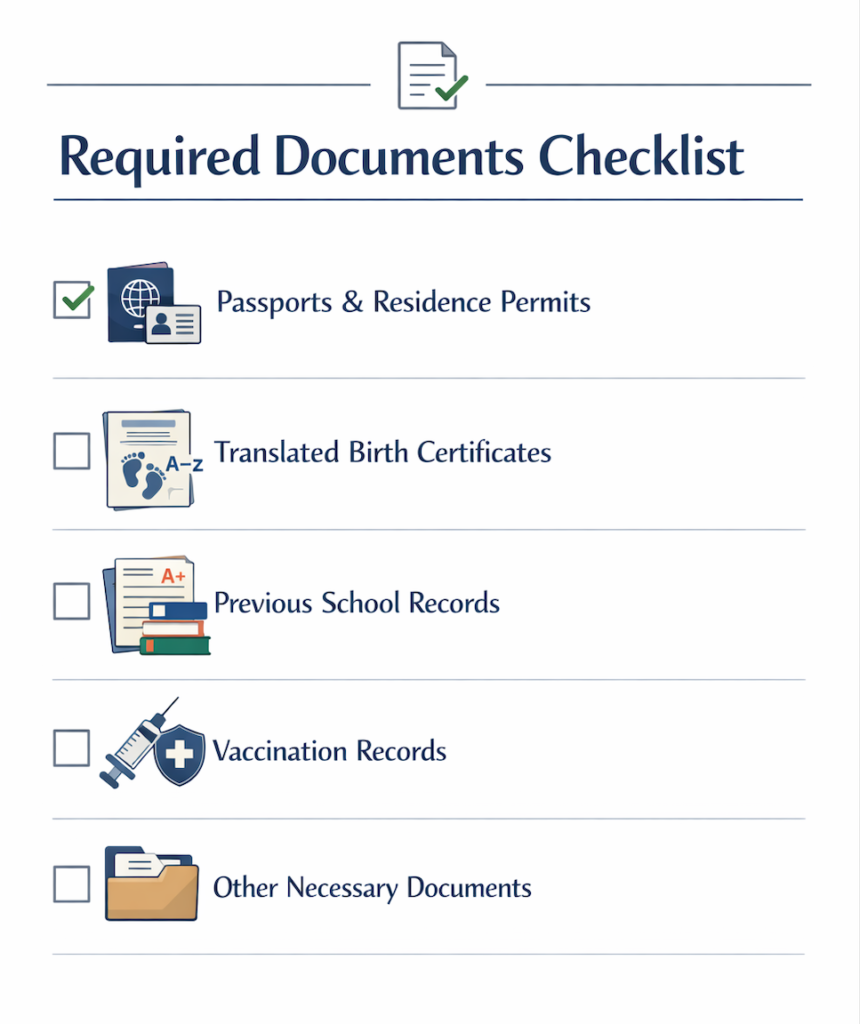
Required Documents Checklist
Oliver’s Pro Tips: Making the Right Choice for YOUR Child
The 7 Critical Questions to Ask Yourself Before Choosing
Making the final call is a deeply personal decision. Here are the questions I encourage every family to discuss honestly:
- What is my child’s personality and learning style—do they thrive in a structured or more creative environment?
- What are our family’s long-term plans (5+ years)? Are we staying in Cyprus, returning home, or moving elsewhere?
- What is our absolute maximum annual budget, including all the hidden costs?
- How important is an English-only environment versus gaining fluency in Greek?
- Does the school’s curriculum align with our preferred university destinations?
- What is the realistic daily commute from the neighborhoods we are considering for our home?
- Are specific after-school activities like sports, arts, or music a non-negotiable priority for my child’s development?
The “Third Option”: Are Greek Private Schools a Fit for Your Family?
Beyond the international schools, there’s another excellent choice many expats overlook: Greek private schools. These institutions follow the Cypriot national curriculum but offer smaller class sizes, superior facilities, and a strong emphasis on English as a second language. With annual tuition fees often in a more affordable range (€4,000–€10,000), they represent a fantastic middle ground. They are ideal for families committed to staying in Cyprus long-term. Several of my past clients with older children have thrived in this environment, becoming fully bilingual while benefiting from a high-quality education at a lower cost.
Find Your Family Home Near Cyprus’s Best Schools
Ready to align your home with the perfect school? The process can feel overwhelming, but it doesn’t have to be. Having lived here for 16 years and guided countless families through this exact journey, my team and I specialize in finding properties located within the most desirable school districts. Whether you’re looking for a villa near a top Limassol school or need to rent property in Cyprus while you get settled, we can match your family’s needs for a seamless relocation. Let’s start the search.
Frequently Asked Questions
Can my child switch from public to private school later on?
Yes, switching from public to private school is common, but timing is key. The transition works best at natural academic breakpoints, such as after primary school or before the main exam years. You should expect the private school to conduct an academic assessment to place your child correctly. With some preparatory tutoring, I’ve helped families make this transition smoothly.
Are there good schools for children with special educational needs (SEN)?
Yes, a number of leading private schools have dedicated SEN departments with qualified staff to provide support. Schools like The Heritage in Limassol have well-regarded inclusivity programs that offer tailored learning plans and access to on-site therapists, ensuring children with additional needs can succeed. Always discuss your child’s specific requirements directly with the school’s admissions office.
What happens if we arrive mid-school year?
Mid-year enrollment is often possible at private international schools, provided they have space available. It is much more challenging in the public system. My advice is to contact your shortlisted schools at least 3-4 months before your intended arrival to inquire about potential openings and plan for any necessary catch-up sessions.
How competitive are places in top private schools for 2026?
For 2026, I expect places to be very competitive. Due to the high influx of relocating professionals, top-tier schools like Foley’s or The English School often fill 80% of their available spots by the spring preceding the academic year. Applying early is critical; waitlists are now the norm, not the exception.
Do schools assist with the student visa process for non-EU children?
Many international schools are experienced in this area and will assist by providing the necessary acceptance letters and documentation required for student visa applications. However, the visa process itself is the family’s responsibility. It’s crucial for non-EU families to secure their residency permits in parallel, and coordinating these processes with a relocation expert can improve efficiency.