
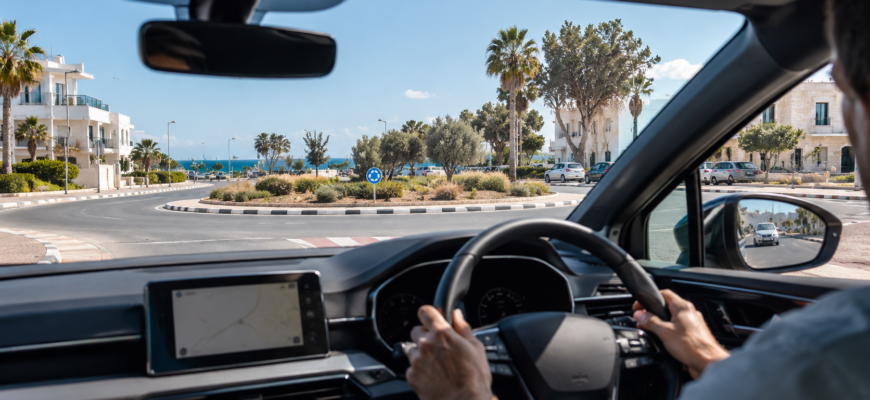
- Your Driving Licence Status in Cyprus: The First Critical Check
- Driving with an EU / EEA Licence
- Driving with a Non-EU Licence (UK, US, Canada, etc.)
- The International Driving Permit (IDP)
- How to Exchange Your Foreign Licence for a Cypriot One: A Step-by-Step Guide
- Step 1: Gather Required Documents
- Step 2: Visit the Department of Road Transport (DoRT)
- Step 3: Submit Application and Pay Fee
- Core Cyprus Road Rules for Expats
- Driving Side: Left is Law
- Speed Limits (in km/h)
- Roundabout Navigation
- Alcohol and Driving
- Mobile Phones and Seatbelts
- Common Signs, Fines, and Penalties
- Understanding Key Road Signs
- Parking Rules and Fines
- Speeding and Traffic Cameras
- Vehicle Ownership: Renting vs. Buying
- Renting a Car
- Buying a Car in Cyprus
- Understanding Car Plates
- Top 5 Common Mistakes Expats Make on Cypriot Roads
- Frequently Asked Questions (FAQ)
By Oliver Bennett, a long-term expat in Cyprus, based on his firsthand experience and extensive research into the 2026 regulations.
Your Driving Licence Status in Cyprus: The First Critical Check
After moving here in 2010, one of the first bureaucratic hurdles I had to navigate was my driving licence. Let’s be honest, understanding the rules is the first step to feeling at home on the roads here. The regulations for your driving licence in Cyprus split clearly depending on where your original licence was issued.
Driving with an EU / EEA Licence
For the first six months after you officially become a resident, you can continue driving in Cyprus using your valid EU/EEA licence. Once you pass that six-month mark, you are legally required to exchange it for a Cypriot one. Thankfully, this process is quite straightforward and does not require you to take a new driving test, just some paperwork.
Driving with a Non-EU Licence (UK, US, Canada, etc.)
You are permitted to drive on your valid foreign licence for up to six months after becoming a resident. After this grace period, you MUST exchange it for a Cypriot driving licence. The exact process can vary slightly depending on your country of origin and any bilateral agreements in place.
Licence Exchange Requirements by Country Origin
| Country/Region | Action Required After 6 Months | Test Required? |
| EU/EEA | Exchange for Cypriot licence | No |
| UK | Exchange for Cypriot licence | No |
| USA/Canada | Exchange for Cypriot licence | Depends on shifting bilateral agreements; often no full test is needed, but always verify with your embassy upon arrival. |
| Australia | Exchange for Cypriot licence | No |
The International Driving Permit (IDP)
An International Driving Permit (IDP) serves as an official translation of your native driver’s licence into multiple languages. It is highly recommended for non-EU visitors staying for a short period or as a useful supplement during your first six months of residency.
⚠️ Crucial Note: An IDP is NOT a substitute for exchanging your licence after the six-month residency period has elapsed; it is only a temporary facilitator.
How to Exchange Your Foreign Licence for a Cypriot One: A Step-by-Step Guide
Step 1: Gather Required Documents
Before you go anywhere, get your paperwork in order. This is a non-negotiable step that will save you a second trip. You will need the following:
- Application form Τ.Ο.Μ. 7Δ
- Your valid foreign driving licence (you must present the original and a photocopy)
- Your passport (original and a photocopy of the main photo/data page)
- Residence Permit / ‘Yellow Slip’ (original and a photocopy)
- Two recent passport-sized photographs that meet standard specifications
- Proof of six months of continuous residency (e.g., utility bills, rental agreements)
Step 2: Visit the Department of Road Transport (DoRT)
With all your documents in hand, locate your nearest District Office of the Department of Road Transport.
💡 Insider Tip: Arrive early in the morning, ideally before they even open, to avoid the notoriously long queues that build up later in the day.
Step 3: Submit Application and Pay Fee
Present your complete document package to the official and pay the required administrative fee. The fee amount for 2026 is approximately €30, although it’s always wise to check for any recent updates. The entire process for receiving your new Cypriot licence typically takes between two to four weeks.
Core Cyprus Road Rules for Expats
Navigating the local driving culture involves more than just knowing your way around; it requires understanding the fundamental Cyprus driving rules.
Driving Side: Left is Law
Cyprus traffic drives on the left-hand side of the road, and overtaking is performed on the right. This is the single most critical rule to internalize, especially for friends visiting from the US or mainland Europe. I once saw a new arrival drive straight into a busy roundabout the wrong way within their first week—a costly and dangerous mistake.
Speed Limits (in km/h)
Speed limits are clearly posted but follow a standard pattern. They are always in kilometres per hour, not miles.
- Motorways: 100 km/h (with a minimum required speed of 65 km/h)
- Main/Rural Roads: 80 km/h
- Built-up Areas: 50 km/h
Fines for speeding are significant, are issued by camera or police, and are calculated based on the percentage you were driving over the limit (e.g., €2 per km/h over the limit if you are up to 30% over, rising to €3 and €5 per km/h for higher brackets).
Roundabout Navigation
Yield to any traffic that is already on the roundabout, which will be approaching from your right. Signalling your intentions is key: use your left indicator to signal your exit and your right indicator if you are continuing around the roundabout past the first available exit.
Alcohol and Driving
The legal blood alcohol limit is extremely low and strictly enforced: 0.22 mg/ml (or 22 µg/100 ml) in a breathalyzer test. For drivers with less than 3 years of experience, the limit drops to an absolute zero-tolerance level of 9 mg/100 ml.
The “just one drink and I’ll be fine” rule absolutely does not apply here. Penalties are severe and range from €125 to €500 or direct court referral. The only safe rule is to not drink at all if you’re driving.
Mobile Phones and Seatbelts
- Using a mobile phone while driving (including texting or holding it to your ear) is strictly illegal and carries a fixed fine of €150 (doubling to €300 upon a repeat offence within 3 years). Only a completely hands-free device is permitted.
- Seatbelts are mandatory for all vehicle occupants, in both the front and back seats. Failure to wear one carries a €150 fine.
Common Signs, Fines, and Penalties
Understanding Key Road Signs
While most international signs are used, there are a few you must know without a doubt:
- STOP sign: An octagonal red sign. It doesn’t mean slow down; it means your wheels must come to a complete stop before the line.
- Yield sign: An inverted triangle. You must give way to all traffic on the major road you are about to enter.
- No Parking: A blue circle with a red border and a single red diagonal line.
- No Stopping: A blue circle with a red border and a red ‘X’ through it. This is more restrictive than No Parking.
Parking Rules and Fines
- Double yellow lines: Indicate absolutely no parking at any time. Don’t even think about it. (Fine: €100)
- Single yellow lines: Parking restrictions apply during specific times, which will be indicated on nearby signs.
- Parking against the flow of traffic or on a pavement is illegal (Fine: €100).
- Parking in a disabled space carries an automatic fine of up to €300.
Speeding and Traffic Cameras
Cyprus has invested heavily in a network of fixed and mobile traffic cameras. These cameras automatically capture speeding, phone use, and red-light infractions. The resulting fines are issued automatically to the registered owner of the vehicle.
Vehicle Ownership: Renting vs. Buying
Renting a Car
For newcomers or those on extended stays, renting is a common starting point. Most rental companies require drivers to be over 25 years old or will charge a ‘young driver’s fee’. My advice is to always opt for the full insurance package for peace of mind. For those considering a longer visit to test the waters before moving, securing a flexible apartment is just as important; you can find excellent options for long term rentals in Cyprus to match your temporary transport.
Buying a Car in Cyprus
When you decide to buy a property and settle down, owning a car becomes a necessity. When purchasing a used vehicle, my number one rule is to always get a full mechanical inspection from a trusted independent garage. The key administrative steps include completing the transfer of ownership at the Department of Road Transport, arranging your insurance policy, and paying the annual road tax. For the property side of your move, working with trusted experts is vital. Our strategic partners at DOM, a leading real estate agency in Cyprus, have an impeccable track record of helping expats find their perfect home.
Understanding Car Plates
The colour of a car’s number plate can tell you a lot about the driver:
- White/Yellow Plates (Front/Back): Standard private vehicles owned by residents.
- Red Plates: These denote rental cars. It’s wise to be extra cautious and patient around them, as the drivers are likely tourists unfamiliar with the roads.
- Z-Plates (Duty-Free): These are on cars imported by certain expats under a specific duty-free status, often linked to residency or work permits.
“My biggest piece of advice when buying a used car here is to check its MOT history online. It’s a simple step that can save you thousands. Don’t just trust the seller’s word; verify everything.”
— Oliver Bennett, Private Realtor & Cyprus Expat
Top 5 Common Mistakes Expats Make on Cypriot Roads
- Misjudging Roundabouts: Not yielding to traffic approaching from the right or using incorrect (or no) indicators is a classic expat mistake.
- Pro-Tip: If you plan to take the first or second exit, stay in the left lane from the beginning. This simple habit prevents a lot of confusion and angry honks.
- Forgetting the Low Drink-Drive Limit: Many expats assume the Blood Alcohol Content (BAC) limit is the same as in their home country. This is a dangerous assumption.
- Pro-Tip: The rule is simple. If you’re the designated driver for the evening, stick to zero-alcohol beverages. It’s not worth the risk.
- Parking Illegally: The habit of parking against the flow of traffic is particularly common among new arrivals. While it might seem convenient and you may see others do it, it’s illegal and a favourite ticket for parking wardens.
- Not Carrying Documents: You are legally required to have your driving licence, car insurance certificate, and MOT certificate with you in the car at all times. Police perform spot checks, and missing paperwork leads to preventable fines.
- Underestimating Local Driving Styles: Cyprus driving can feel more assertive or dynamic than what you might be used to. Drivers may seem impatient. The key is not to become aggressive yourself, but to adopt a defensive, highly aware driving style. Always anticipate the unexpected.
Frequently Asked Questions (FAQ)
Do I need to take a driving test to get a Cypriot licence?
If you are exchanging a valid licence from an EU member state or a select list of non-EU countries with bilateral agreements (like the UK, Australia, etc.), you do not need to take a driving test. For licence holders from most other countries, a full practical and theory test will be required.
What are ‘anarotikes’ cameras in Cyprus?
This is the local Greek term used for traffic light and photo-enforcement cameras. These sophisticated devices automatically photograph any vehicle that crosses the line after the light has turned red, or detects drivers speeding, using mobile phones, or omitting seatbelts.
Can I drive in North Cyprus with a car rented in the South?
This depends entirely on your rental company’s insurance policy. The vast majority of standard insurance policies from companies in the Republic of Cyprus do not cover driving in the North. To do so, you typically need to purchase a separate, third-party insurance policy at the border crossing. Always confirm with your rental firm before you travel.
Is driving in Cyprus difficult for an American or European?
The single biggest challenge for most is adapting to driving on the left-hand side of the road. Beyond that, the experience of driving in Cyprus is quite manageable. The main road network is generally well-maintained, and crucial directional and warning signs are in both Greek and English. The best approach is to be a patient, defensive driver.