
- Author’s Note: My 16-Year Perspective on the Evolving Cyprus Property Market
- Why Choose Cyprus for Your Property Investment in 2026?
- Strategic Appeal: A Resilient Mediterranean Hub
- Financial Incentives: Maximizing Your Investment
- Unmatched Lifestyle: Safety, Climate, and EU Membership
- The Cyprus Real Estate Market Outlook for 2026: Prices & Trends
- 2026 Economic Forecasts & Impact on Property Values
- Key Infrastructure Projects Shaping the 2026 Landscape
- Demand Drivers: Investment vs. Lifestyle Purchases
- Best Places to Buy in Cyprus: A 2026 Regional Analysis
- The “Big Three” Investment & Lifestyle Hubs
- Paphos: The Premier Choice for Expats and Holiday Homes
- Limassol: The Cosmopolitan Core for Business & Luxury Living
- Larnaca: The Rising Star with Major Redevelopment & Value
- Other Key Areas to Consider
- Ayia Napa & Protaras: The Kings of Holiday Rentals
- Nicosia: The Capital for Urban Living & Stable Local Demand
- An Overview of Property and Home Types in Cyprus
- The A-to-Z Buying Process: Your Step-by-Step Guide for 2026
- Step 1: Secure Your Finances & Define Your Budget
- Step 2: Appoint an Independent Lawyer (Your Most Crucial Decision)
- Step 3: Find Your Property & Make a Formal Offer
- Step 4: The Legal Due Diligence Your Lawyer MUST Perform
- Verifying Title Deeds: The #1 Priority for a Secure Purchase
- Checking for Mortgages or Encumbrances (Property Search)
- Confirming Building Permits & Planning Authorizations
- Step 5: Sign the Contract of Sale & Stamp It at the Tax Office
- Step 6: Apply for Council of Ministers’ Permit (for Non-EU/UK Buyers)
- Step 7: Final Completion & Transfer of Title Deeds at the Land Registry
- The Real Cost: A Complete Budget Breakdown
- One-Off Taxes & Fees (The Purchase Costs)
- Ongoing Costs of Ownership
- Who Can Buy Property in Cyprus? Rules for Foreigners Explained
- For EU Citizens: Unrestricted Ownership
- For UK Citizens (Post-Brexit): The New Realities
- For Other Non-EU Nationals: The Council of Ministers’ Permit
- Residency & Lifestyle: The Benefits Beyond the Bricks
- The Cyprus Permanent Residency Program via Property Investment
- Investing in a Holiday Home: Maximizing Rental Yields in 2026
- Top 7 Mistakes Foreign Buyers Make (And How to Avoid Them)
- Find Your Dream Property in Cyprus Today
- Frequently Asked Questions (FAQs)
Last Updated: October 2024 | Written by Oliver Bennett, a Cyprus resident and real estate advisor with 16 years of firsthand experience helping families and investors find homes here. Reviewed for legal accuracy by Georgiades & Associates LLC.
Author’s Note: My 16-Year Perspective on the Evolving Cyprus Property Market
I arrived in Cyprus back in 2010 thinking it would be a short chapter. Sixteen years later, I still wake up to the Mediterranean sun every morning and help people do the same. What has changed most since then is not just property prices, but the buyers themselves. Today, more families arrive with remote-work setups, investors look for stable, long-term yields rather than quick flips, and everyone asks sharper questions about title deeds and residency paths. This guide reflects what I have learned on the ground, not in a seminar room, and I’ve designed my Cyprus Life & Real Estate Blog to share these real-world lessons.
Why Choose Cyprus for Your Property Investment in 2026?
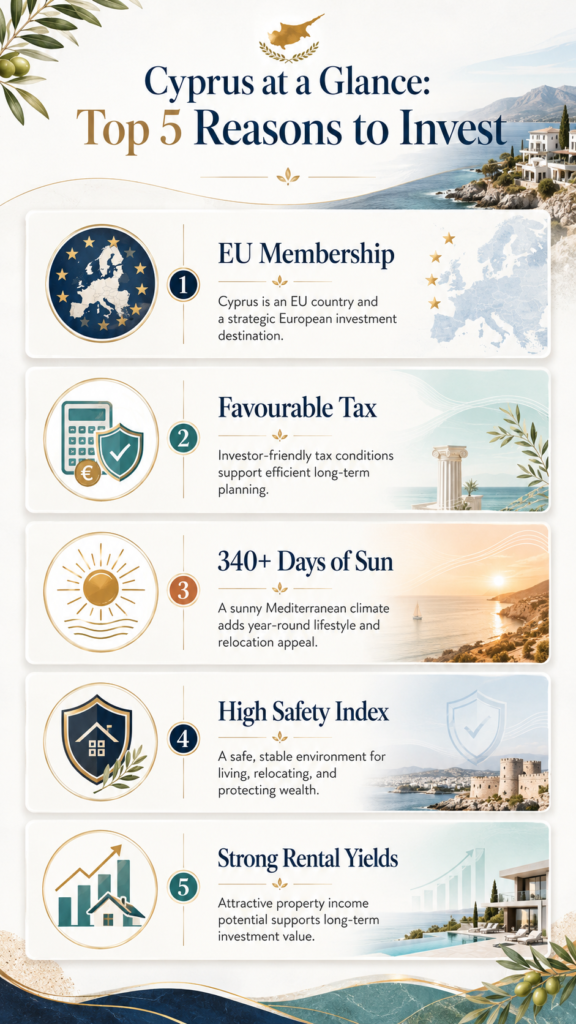
So, what is Cyprus in 2026? For many investors and relocators, Cyprus is a strategic safe haven inside the European Union, yet outside the intense volatility some mainland countries face. It’s a place blessed with reliable sunshine, an exceptionally low crime rate, and a welcoming, English-speaking business environment. For many of my clients, these fundamental quality-of-life factors ultimately matter more than just the headline rental yields when deciding to find a new home in Cyprus.
Strategic Appeal: A Resilient Mediterranean Hub
The post-pandemic world normalized remote work, and people no longer need to live where their office is located. Cyprus offers stable governance, English as a common working language in most business dealings, and rapid flight connections to the rest of Europe, the Middle East, and beyond. This island has consistently demonstrated its resilience, staying calm through regional tensions that have historically unsettled other Mediterranean markets.
Financial Incentives: Maximizing Your Investment
The tax on rental income remains comparatively low against many other EU states, and the framework for handling Cyprus property investment is well-established. New-build purchases can benefit from VAT exemptions or a reduced 5% rate when the buyer meets specific primary residency conditions. With tourism having rebounded strongly since 2022, occupancy rates for well-located holiday homes are now pushing back toward, and sometimes exceeding, pre-pandemic record levels, reinforcing its appeal as a high-yield asset class.
Unmatched Lifestyle: Safety, Climate, and EU Membership
The ability to walk alone at night in most neighbourhoods and feel completely safe is a benefit that cannot be overstated. The summers are long and inviting, while winters remain temperate and mild. Crucially, EU membership means your property rights are protected within a recognized and robust legal framework, which provides essential security when you eventually decide to sell or pass the asset on to your children.
The Cyprus Real Estate Market Outlook for 2026: Prices & Trends
Data from the Cyprus Statistical Service shows that the value of property in Cyprus rose steadily through 2025 and into 2026, with coastal districts leading the growth. The market is no longer the “wild west” it might have been a decade ago; current growth is more sustainably tied to tourism recovery and major infrastructure investments.
“In 2026, we’re seeing a bifurcation in the market. While coastal areas like Paphos are driven by lifestyle and rental demand, Limassol’s growth is fueled by key infrastructure projects and corporate relocation.” — Oliver Bennett, Cyprus Real Estate Advisor
2026 Economic Forecasts & Impact on Property Values
GDP growth projections from sources like Eurostat sit around a healthy 3% for the year, a strong indicator of economic stability. Inflation has cooled from its recent peaks, which positively impacts mortgage affordability for domestic and foreign buyers alike. The correlation between economic expansion and property prices remains clear: stronger growth consistently lifts values in the districts where new residents and international businesses choose to settle.
Key Infrastructure Projects Shaping the 2026 Landscape
Larnaca’s transformative marina and port redevelopment continues to capture significant attention from both strategic investors and lifestyle-focused end-users. In Limassol, the integrated casino resort now operates at full capacity, driving year-round footfall and commercial activity. These large-scale projects act as powerful anchors, supporting rental demand and property values in their surrounding districts.
Demand Drivers: Investment vs. Lifestyle Purchases
Lifestyle buyers, often seeking a second home or a complete relocation, continue to favor Paphos and the scenic Protaras coastline. In contrast, investors chasing higher rental yields and capital appreciation tend to focus on Limassol and Larnaca, where a concentration of corporate relocations and airport proximity help keep occupancy rates steady, even outside the peak summer season.
Best Places to Buy in Cyprus: A 2026 Regional Analysis
Choosing a location is the most personal decision you will make. Before you get lost in listings, let’s break down the character of each major area. You can explore a wide range of options to buy property in Cyprus that have passed our due diligence checks.
The “Big Three” Investment & Lifestyle Hubs
Paphos: The Premier Choice for Expats and Holiday Homes
Paphos offers the most convenient airport access for the majority of European flights and hosts a large, well-established expat community. Many of my clients looking for a holiday home or permanent residence choose the picturesque hills just above the coast, which offer tranquility and stunning sea views. Average property prices here remain more accessible when compared to their Limassol equivalents.
Limassol: The Cosmopolitan Core for Business & Luxury Living
Limassol rightly maintains its reputation as the island’s cosmopolitan business hub, continually attracting international companies and high-net-worth individuals. Apartments fronting the marina command the highest prices on the island, yet the city’s strong corporate backbone ensures solid long-term rental demand across various price points.
Larnaca: The Rising Star with Major Redevelopment & Value
Larnaca’s ongoing marina project and its proximity to the island’s main international airport position it perfectly for both capital growth and convenience. Property prices here have not yet risen as sharply as in Limassol, presenting a window of opportunity for investors and homebuyers who act now to secure assets at a favorable price point.
Other Key Areas to Consider
Ayia Napa & Protaras: The Kings of Holiday Rentals
These eastern coastal areas boast some of Europe’s finest beaches, attracting intense seasonal tourism. A well-managed two-bedroom apartment here can achieve exceptionally high occupancy rates during the summer, though owners must be prepared for three to four much quieter winter months. They are ideal for pure rental-focused investments.
Nicosia: The Capital for Urban Living & Stable Local Demand
As the capital city, Nicosia offers a different proposition: a stable market driven by local tenants, government employees, and university students. Rental yields are typically lower than in prime coastal areas, but the market experiences far fewer seasonal fluctuations, providing a more predictable income stream.
An Overview of Property and Home Types in Cyprus
- Apartments: The perfect choice for city living, a low-maintenance holiday home, or as a first step onto the property ladder. They often come with access to communal pools and are easy to lock up and leave.
- Villas: These standalone homes, often featuring private pools and gardens, are immensely popular in coastal areas for luxury living and generating high-yield rental income from tourists seeking privacy and space.
- Townhouses/Maisonettes: A fantastic blend of apartment convenience and villa space. Usually found in residential complexes, they offer multiple floors of living space, private outdoor areas, and access to shared amenities like pools and gyms.
- Bungalows: These single-story homes are highly favored for their accessibility and easy maintenance, making them an excellent choice for retirees or anyone wishing to avoid stairs. They often come with sizable land plots.
- Land Plots: For those who want to build a custom dream home. This path requires careful due-diligence on building zones, permits, and access to utilities, but offers ultimate control over the final product.
The A-to-Z Buying Process: Your Step-by-Step Guide for 2026
Step 1: Secure Your Finances & Define Your Budget
Start with a crystal-clear budget ceiling that accounts for all associated taxes and fees (typically 8-10% of the purchase price), not just the headline price of your potential home in Cyprus.
Step 2: Appoint an Independent Lawyer (Your Most Crucial Decision)
My strongest advice: never, ever accept the lawyer suggested by the property developer or the seller. An independent lawyer works exclusively for you and is your first line of defense.
Step 3: Find Your Property & Make a Formal Offer
Once you find a property, a reservation agreement, accompanied by a modest deposit (usually 1-2% of the price), takes it off the market while your lawyer begins the critical due diligence process.
Step 4: The Legal Due Diligence Your Lawyer MUST Perform
Verifying Title Deeds: The #1 Priority for a Secure Purchase
Title Deeds are the official proof of ownership registered at the Land Registry. Without them for a resale property, you cannot legally register the property in your name or use it as collateral.
Checking for Mortgages or Encumbrances (Property Search)
A comprehensive Land Registry search is non-negotiable. It reveals any outstanding developer mortgages, liens, or other legal claims filed against the property that could jeopardize your ownership.
Confirming Building Permits & Planning Authorizations
Your lawyer must confirm that the property was constructed with all the proper permits and that its current state matches the architectural plans on file at the local authority.
Step 5: Sign the Contract of Sale & Stamp It at the Tax Office
After successful due diligence, you sign the Contract of Sale. Your lawyer then stamps it at the tax office and lodges it with the Land Registry, which secures your purchase rights against the title.
Step 6: Apply for Council of Ministers’ Permit (for Non-EU/UK Buyers)
For non-EU buyers, your lawyer will submit a straightforward application for permission to own property. In 2026, with all documents in order, this process typically takes between six to ten weeks.
Step 7: Final Completion & Transfer of Title Deeds at the Land Registry
Once your full payment clears and the permit is granted (if applicable), the transfer of the Title Deeds into your name happens at the District Land Registry, marking the final step.
The Real Cost: A Complete Budget Breakdown
One-Off Taxes & Fees (The Purchase Costs)
Value Added Tax (VAT) primarily applies to new-build properties, at either a standard rate of 19% or a reduced rate of 5% for an eligible buyer’s first and primary residence. Stamp Duty is a modest tax on the contract value. Property Transfer Fees apply to resale properties (where no VAT is paid) and follow a sliding scale based on the property’s value.
Ongoing Costs of Ownership
The old annual Immovable Property Tax has been abolished, which is great news for owners. Annual bills now mainly consist of local authority fees (for services like refuse collection), sewerage charges, and, for properties in shared complexes, communal fees for maintenance of pools, gardens, and elevators.
Who Can Buy Property in Cyprus? Rules for Foreigners Explained
For EU Citizens: Unrestricted Ownership
Citizens of any EU member state face no restrictions on the number or type of properties they are permitted to purchase in Cyprus. The process is identical to that for Cypriot citizens.
For UK Citizens (Post-Brexit): The New Realities
Following Brexit, UK nationals are now treated as third-country nationals. This means they must obtain the same Council of Ministers’ permit as other non-EU buyers, although in practice, approval for one residential property is largely a routine formality.
For Other Non-EU Nationals: The Council of Ministers’ Permit
The permit generally limits a non-EU buyer to a single property in Cyprus, whether it’s an apartment, a house, or a plot of land up to a defined size. Specific large-scale investment schemes may allow for additional purchases under different conditions.
Residency & Lifestyle: The Benefits Beyond the Bricks
The Cyprus Permanent Residency Program via Property Investment
Investing a minimum of €300,000 (plus VAT) in a new-build residential property can qualify you and your direct family for the fast-track Permanent Residency program. This is a popular route for non-EU citizens seeking a secure foothold in Europe. Full, up-to-date details can be found on the official Civil Registry and Migration Department website.
Investing in a Holiday Home: Maximizing Rental Yields in 2026
A holiday home in a proven rental location like Paphos or Protaras can generate solid seasonal income. Professional management companies can handle all aspects of bookings, cleaning, and guest communication for a percentage of the revenue. To understand market demand, it’s also wise to research the thriving long-term rental market to see how different property types perform throughout the year.
Top 7 Mistakes Foreign Buyers Make (And How to Avoid Them)
- Not Hiring an INDEPENDENT Lawyer: Oliver says, “I’ve seen buyers lose their deposits because the developer’s ‘recommended’ lawyer wasn’t truly representing their interests. It’s the costliest shortcut you can take.”
- Ignoring Title Deed Issues or Delays: Oliver says, “A property tangled in title deed problems creates long-term headaches that are expensive and difficult to unwind. If the deeds aren’t clean and ready, you should be asking serious questions or walking away.”
- Underestimating the Total Purchase & Ongoing Costs: Oliver says, “Always budget an extra 8–10% above the purchase price. This covers all taxes, legal fees, and the first year of ownership costs without any nasty surprises.”
- Skipping a Professional Structural Survey: Oliver says, “Especially with older properties, hidden defects like damp or structural issues can cost far more to fix than the few hundred euros you’d spend on a proper survey.”
- Failing to Check the Developer’s Track Record: Oliver says, “A glossy brochure tells you nothing. Look at their previously completed projects. Talk to people who live there. Past performance is the best indicator of future quality.”
- Making False Assumptions About Residency Rights: Oliver says, “Buying a home doesn’t automatically grant you the right to live here full-time if you’re a non-EU citizen. The property purchase and the residency application are two separate, though often linked, processes.”
- Misunderstanding Inheritance Laws in Cyprus: Oliver says, “Cyprus has forced-heirship rules that can dictate how your property passes to your heirs, potentially overriding your will. It’s vital to get proper legal advice on this to ensure your wishes are met.”
Find Your Dream Property in Cyprus Today
Ready to move forward from research to reality? Take the next step by browsing a curated selection of properties that meet our strict criteria for investment potential and clear title status. Or, if you prefer, reach out for a direct, no-fluff conversation about your plans. You can begin exploring available homes for sale right now.
Frequently Asked Questions (FAQs)
Can I get permanent residency by buying property in Cyprus?
Yes, the Permanent Residency Program is available for non-EU investors who purchase a new property in Cyprus valued at over €300,000 plus VAT. As discussed in the residency section above, this is a popular pathway to securing EU residency.
What’s the difference between VAT and Property Transfer Fees?
They are mutually exclusive. VAT applies to the purchase of most new-build properties. Property Transfer Fees apply to the purchase of all resale properties. You will pay one or the other, but never both on the same transaction.
How long does the entire buying process take in 2026?
For EU citizens, the process typically concludes within one to three months. For non-EU buyers who require the Council of Ministers’ permit, a realistic timeline is between three to five months from start to finish.
What are the risks of buying a property without Title Deeds?
The primary risk is that you do not have indisputable legal ownership. This means you cannot easily sell the property, secure a loan against it, and you remain vulnerable if the original developer goes into debt. I strongly advise against purchasing any resale property that does not have its Title Deeds issued and available for transfer.
As a non-EU citizen, can I buy more than one property?
The standard permit granted by the Council of Ministers is for one residential property (an apartment, a house, or a plot of land of a certain size). Acquiring additional properties generally requires separate approvals, often linked to formal business or large-scale investment schemes.