

- The Unbeatable 2026 Cyprus Tax Regime
- Favorable 12.5% Corporate Tax Rate
- Tax Exemptions: Dividends, Capital Gains, and the Non-Dom Status
- The Cyprus IP Box Regime: A Tax Haven for Tech & R&D
- Access to 65+ Double Tax Treaties
- A Pro-Business EU Hub
- Strategic Gateway to EU, African, and Middle Eastern Markets
- Stable Economic and Political Environment
- Access to Skilled, Multilingual Workforce (English is universal in business)
- The Lifestyle Advantage for You and Your Team
- Pros vs. Cons for 2026: An Unbiased View
- Budgeting Your Cyprus Company: A Full Breakdown of Costs for 2026
- One-Time Setup Costs
- Company Registration and Government Fees
- Legal and Professional Service Fees
- Bank Account Opening Fees
- Annual Running Costs
- Registered Office and Secretarial Services
- Accounting, Audit, and Tax Filing Fees
- Annual Company Levy (€350)
- The Cyprus Company Registration Process: A Step-by-Step Guide
- Step 1: Strategic Planning (The Pre-Submission Phase)
- Choosing Your Legal Structure: Why LTD is the Top Choice
- Company Name Approval with the Registrar of Companies
- Appointing Directors, a Secretary, and Shareholders
- Preparing Your Due Diligence Documents (KYC)
- Step 2: Drafting and Submission
- The Memorandum and Articles of Association (M&A)
- Official Submission of All Documents to the Registrar
- Step 3: Post-Registration Activation
- Receiving Your Corporate Certificates
- How to Open a Corporate Bank Account as a Foreigner
- Tax and VAT Registration
- Realistic Timeline: How Long Does It Take in 2026?
- The Crucial Link: How Your Company Unlocks Cyprus Residency & Relocation
- The Company of Foreign Interests (BFU) Pathway for Non-EU Staff
- Obtaining Work & Residence Permits for Owners and Key Employees
- The Permanent Residency Program for Business Owners
- The Digital Nomad Visa: An Alternative for Solopreneurs
- Your Business & The Cyprus Real Estate Market: Strategic Planning for 2026
- Acquiring Your Office: Substance is Key
- Using Your Company to Purchase Residential & Commercial Real Estate
- The Process and Tax/VAT Implications
- Cyprus Real Estate Market Forecast for 2026
- Expert’s Edge: Oliver Bennett’s Insider Guide to Avoiding Common Pitfalls
- Mistake 1: Underestimating the ‘Siga Siga’ Pace of Bureaucracy
- Mistake 2: Navigating Banking Due Diligence Unprepared
- Mistake 3: Neglecting Local Networking and Cultural Nuances
- Mistake 4: Ignoring a Clear Substance Strategy (Office & Staff)
- Beyond the Launch: Annual Compliance & Growth
- Your Annual Compliance Checklist
- Filing Annual Returns & Financial Statements (Audit)
- Paying the Annual Company Levy
- Maintaining Proper Accounting Records
- Finding Local Partners, Accelerators, and Support Networks
- Planning Your Exit Strategy: Selling or Closing a Cyprus Company
- Frequently Asked Questions (FAQ)
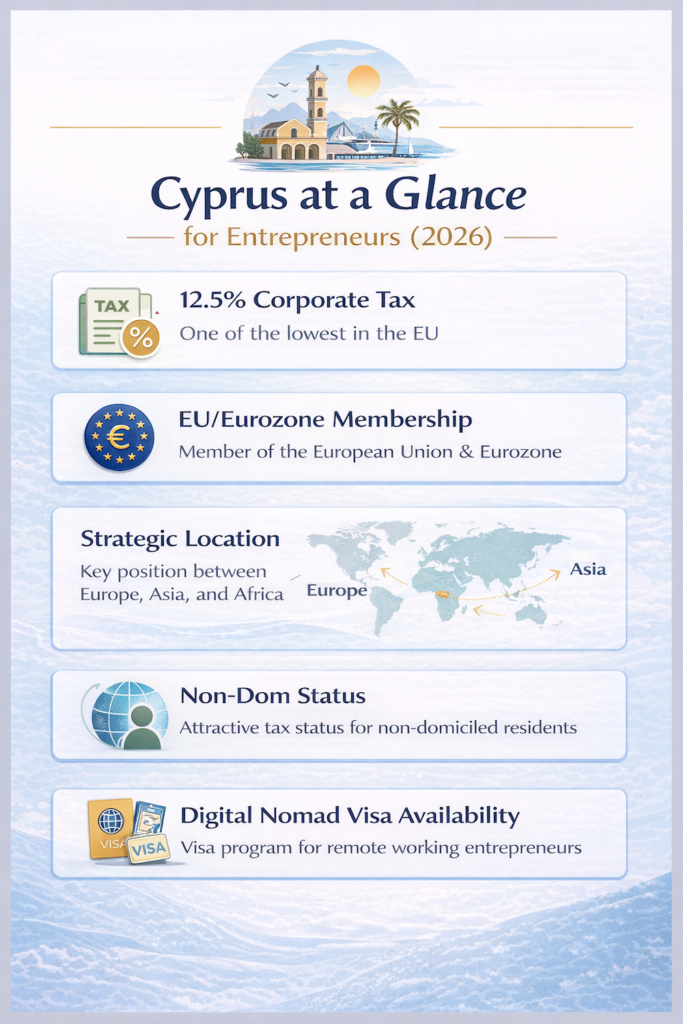
Cyprus consistently draws global entrepreneurs with its compelling blend of low taxation, full EU membership, and a strategic geographic position acting as a bridge between Europe, Asia, and Africa. In 2026, the decision to start a business in Cyprus means gaining entry to a pro-business environment defined by a 12.5% corporate tax rate—among the lowest in Europe—while leveraging benefits like the non-domiciled status, which completely exempts certain foreign income streams from local taxes. Full access to the EU single market opens seamless trade across 27 member nations, and the island’s stable, growing economy provides a solid foundation for ventures in technology, finance, and professional services. Through my work, I’ve seen firsthand how foreign founders turn ambitious ideas into profitable Cypriot companies. The island’s unique value proposition also includes lifestyle advantages like a mild Mediterranean climate, a universally English-speaking business community, and powerful investment incentives such as the IP Box regime for innovators. However, long-term success hinges on navigating the local nuances. If you are exploring entrepreneurship in Cyprus, this guide breaks down the benefits without the usual hype, based on my 16 years of on-the-ground experience.
The Unbeatable 2026 Cyprus Tax Regime
Favorable 12.5% Corporate Tax Rate
Cyprus maintains its highly competitive flat 12.5% corporate tax rate on net profits, a figure that remains unchanged for 2026. This rate is applied after all allowable business expenses are deducted, making it significantly more attractive than the higher EU averages, such as Germany’s approximate 25% rate or France’s 25.8%. For a new technology startup generating €100,000 in net profit, the tax liability would be just €12,500, freeing up substantial capital for reinvestment, hiring, or expansion. In my experience, clients moving from high-tax jurisdictions have frequently managed to reduce their corporate tax burden by over 50% simply by relocating their operations here.
Tax Exemptions: Dividends, Capital Gains, and the Non-Dom Status
Income from dividends and capital gains generated from the sale of securities remains entirely tax-free for companies in 2026, a feature that makes Cyprus an ideal location for holding companies and investment portfolios. Furthermore, the non-domiciled status—a powerful incentive available to foreign nationals who become tax residents but were not born in Cyprus—exempts their worldwide dividend and interest income from taxation. One of my clients recently structured their global investment portfolio through their Cyprus residency and legally avoided any local taxes on over €200,000 in annual investment gains.
The Cyprus IP Box Regime: A Tax Haven for Tech & R&D
The innovative IP box regime dramatically lowers the effective tax rates to as little as 2.5% on qualifying income derived from intellectual property assets like patents, copyrighted software, and other R&D-related IP. For 2026, the regime allows an 80% exemption on qualifying profits after deducting all relevant expenses, making it a powerful tool for technology and research-focused firms. A software development company I advised, which generated €500,000 in eligible IP-related revenue, paid only €12,500 in corporate tax, demonstrating the immense value of this incentive.
Access to 65+ Double Tax Treaties
Cyprus’s extensive network of over 65 double taxation treaties with key economic partners, including the US, UK, China, India, and the UAE, is a cornerstone of its appeal. These agreements ensure that profits earned in one country are not taxed again when repatriated, which eliminates fiscal friction and significantly boosts the efficiency of cross-border business operations. This framework minimizes or completely removes withholding taxes on dividends, interest, and royalties paid out of a Cypriot company.
A Pro-Business EU Hub
Strategic Gateway to EU, African, and Middle Eastern Markets
Positioned at the maritime and aerial crossroads of three continents, Cyprus provides businesses with tariff-free access to the European Union’s market of over 450 million consumers. Simultaneously, its close proximity to emerging markets in Africa and the Middle East creates unique opportunities for trade and expansion. The modern logistics hubs in Limassol and Larnaca efficiently handle international shipments, which allowed an e-commerce client of mine to successfully expand their distribution network into 10 new regional markets last year.
Stable Economic and Political Environment
With the International Monetary Fund projecting steady GDP growth for 2026, Cyprus continues to exhibit a stable and resilient economy characterized by low inflation and the robust backing of EU financial frameworks. The country’s long-standing political neutrality provides a secure and predictable environment, shielding businesses from the geopolitical volatility that can affect other regions. This stability is a key factor for entrepreneurs seeking a reliable base for long-term growth.
Access to Skilled, Multilingual Workforce (English is universal in business)
English is the undisputed language of business in Cyprus, eliminating communication barriers for foreign entrepreneurs. The local universities produce a steady stream of well-educated, tech-savvy graduates, particularly in fields like finance, law, and IT. Crucially, salary expectations are often 20-30% lower than in Western European hubs, allowing companies to build talented teams more cost-effectively. The workforce is also notably multilingual, with many professionals fluent in Russian, Greek, and other European languages, which streamlines international client relations.
The Lifestyle Advantage for You and Your Team
Relocating your operations to Cyprus also means offering your team an unparalleled quality of life. The island boasts over 300 days of sunshine a year, an affordable cost of living (a family can live comfortably on €2,000 a month in many areas), and access to excellent international schools and healthcare. This work-life balance—where a productive day of meetings can be followed by a relaxing evening at the beach—is a powerful tool for talent retention. Having lived this lifestyle myself since 2010, I can attest that it significantly reduces burnout and keeps teams motivated far better than the high-stress environment of many major urban centers detailed in our Cyprus expat blog.
Pros vs. Cons for 2026: An Unbiased View
| Pros | Cons |
| Highly competitive 12.5% corporate tax and numerous exemptions. | The ‘Siga Siga’ (slowly, slowly) pace of bureaucracy can cause delays. |
| Full EU market access and strategic location between three continents. | The local market is relatively small, requiring an export-oriented business model. |
| Exceptional lifestyle with a sunny climate, safety, and low living costs. | Banking due diligence hurdles for non-EU foreigners can be stringent and time-consuming. |
Table 1: A balanced comparison of advantages and disadvantages for foreign entrepreneurs in Cyprus.
Budgeting Your Cyprus Company: A Full Breakdown of Costs for 2026
A clear financial plan is essential to prevent surprises when you start a business in Cyprus. For 2026, you should budget between €3,000 and €10,000 for the initial company setup, a range that covers company registration Cyprus fees, legal and professional services, and the initial bank account opening process. Following the setup phase, annual running costs typically fall between €2,000 and €5,000, which accounts for compliance, accounting, and basic administrative needs. These figures are drawn from real-world client cases: a solo consultant spent approximately €4,500 on their initial setup, whereas a small tech firm with more complex needs reached €8,000. It is also important to factor in the standard 19% VAT rate applicable to most professional services. Using this detailed breakdown will help you align your budget with the scale of your operation; for instance, small business tips often include starting with a virtual office to minimize initial overheads.
One-Time Setup Costs
Company Registration and Government Fees
The fees payable to the Registrar of Companies typically start at around €205 for name approval and the formal incorporation process, with an additional €60 for issuing the necessary corporate certificates. The total government-side expenditure generally ranges from €300 to €500.
Legal and Professional Service Fees
Corporate lawyers or service providers usually charge between €1,000 and €3,000 for managing the entire process, including drafting the Memorandum and Articles of Association and submitting all required documentation. My advice is to work with vetted, reputable firms to avoid hidden costs and ensure compliance.
Bank Account Opening Fees
Leading Cypriot banks like the Bank of Cyprus or Hellenic Bank may levy an account opening fee of €100-€300. More complex due diligence processes, particularly for entities with intricate ownership structures, can add another €500 or more to this cost.
Annual Running Costs
Registered Office and Secretarial Services
A virtual office package, which provides a registered address and mail handling, costs between €500 and €1,000 annually. For businesses requiring a physical presence to establish substance, a dedicated office space for rent starts at €2,000 and up per year, depending on location and size.
Accounting, Audit, and Tax Filing Fees
Basic annual accounting and bookkeeping services typically range from €1,000 to €2,500. If your company’s turnover requires a statutory audit, you should budget an additional €2,000 or more, depending on the volume of transactions.
Annual Company Levy (€350)
A fixed annual levy of €350 is payable to the Registrar of Companies by June 30th of each year. Timely payment is crucial to maintain good standing and avoid financial penalties.
| Item | Low Estimate | Average Estimate | High Estimate |
| Government Fees | €300 | €400 | €500 |
| Professional Services | €1,000 | €2,000 | €3,000 |
| Virtual Office | €500 | €750 | €1,000 |
| Accounting | €1,000 | €1,500 | €2,000 |
| Total | €2,800 | €4,650 | €6,500 |
Estimate Your First-Year Costs
The Cyprus Company Registration Process: A Step-by-Step Guide
The company registration Cyprus framework is a structured procedure managed by the Registrar of Companies, with the entire process typically taking between one and three weeks in 2026. The journey begins with applying for company name approval, followed by the preparation of the Memorandum and Articles of Association, the appointment of company officers, and the collection of all necessary Know-Your-Customer (KYC) documents. Government fees amount to €300-€500, with additional costs for professional services. Once the company is officially registered, the next steps involve securing a tax identification number, completing VAT registration if the turnover threshold is met, and opening a corporate bank account. As someone who has guided over 100 registrations, I must stress the importance of meticulous due diligence—incomplete or incorrect documents can delay the entire timeline. Foreigners do not need to be residents to own a company, but a local registered address is a mandatory requirement. This process results in a fully EU-compliant corporate entity, unlocking access to tax treaties and the single market. Following these steps carefully ensures a smooth and efficient setup.
Step 1: Strategic Planning (The Pre-Submission Phase)
Choosing Your Legal Structure: Why LTD is the Top Choice
The legal requirements in Cyprus make the Private Company Limited by Shares (LTD) the most advantageous and popular structure for foreign entrepreneurs. It provides limited liability protection, shielding personal assets from business debts, and allows for 100% foreign ownership. Unlike a sole tradership (which carries unlimited personal liability) or a partnership (which requires shared control and liability), an LTD is a distinct legal entity that is ideal for most commercial ventures, requiring a minimum share capital of just €1. In my experience, over 90% of international clients choose the LTD structure for its scalability and credibility. One e-commerce founder I worked with structured his venture as an LTD specifically to position it for future investor funding.
Company Name Approval with the Registrar of Companies
Submit up to three unique company name options to the Registrar online. The approval process usually takes two to five business days, provided the names are distinctive, not offensive, and do not infringe on existing trademarks.
Appointing Directors, a Secretary, and Shareholders
A minimum of one director is required, who can be of any nationality and reside anywhere. A company secretary must also be appointed. Shareholders own the equity in the company, and there are no residency restrictions for them either.
Preparing Your Due Diligence Documents (KYC)
Assemble the necessary Know-Your-Customer (KYC) documents for all directors, shareholders, and ultimate beneficial owners. This typically includes certified copies of passports, recent utility bills as proof of address, and professional curriculum vitae (CVs). Both the Registrar and banks require these for anti-money laundering (AML) compliance.
Step 2: Drafting and Submission
The Memorandum and Articles of Association (M&A)
These foundational documents outline the company’s objectives, the scope of its activities, and its internal governance rules. A corporate lawyer typically drafts the M&A for a fee ranging from €500 to €1,000, ensuring it aligns with your business goals and Cypriot law.
Official Submission of All Documents to the Registrar
Once all documents are prepared and signed, they are filed with the Registrar of Companies, either electronically or in person. The standard processing time for incorporation is between five and ten working days.
Step 3: Post-Registration Activation
Receiving Your Corporate Certificates
Upon successful registration, the Registrar issues a set of corporate certificates, including the Certificate of Incorporation, Certificate of Directors and Secretary, and Certificate of Registered Address. These documents officially prove the company’s legal existence.
How to Open a Corporate Bank Account as a Foreigner
Securing banking for business is a critical post-registration step that requires a robust KYC package, including passports of owners, a detailed business plan, and proof of source of funds. Major Cypriot banks like Hellenic Bank and Bank of Cyprus often require an in-person visit or video call for non-residents and meticulously scrutinize documents. The process usually takes two to four weeks, with fees around €100-€300. A client of mine initially faced rejections due to a perceived weak connection to Cyprus, highlighting the importance of preparation as detailed in the ‘Avoiding Pitfalls’ section below. Emphasizing your business ties to the EU can facilitate the approval process.
Tax and VAT Registration
VAT registration becomes mandatory once a company’s annual taxable turnover exceeds the €15,600 threshold. The standard VAT rate is 19%. An application must be submitted to the Tax Department to obtain a VAT number and a VIES (VAT Information Exchange System) registration, which is essential for EU compliance and cross-border transactions. This process typically takes one to two weeks.
Realistic Timeline: How Long Does It Take in 2026?
The complete company registration Cyprus process, including opening a bank account, realistically takes between two and four weeks. However, potential bureaucratic delays can sometimes add another one or two weeks, so it is prudent to plan for a total timeline of one to two months from start to finish.
The Crucial Link: How Your Company Unlocks Cyprus Residency & Relocation
The Company of Foreign Interests (BFU) Pathway for Non-EU Staff
Establishing a Company of Foreign Interests (BFU) is the primary mechanism for relocating non-EU talent. This designation requires at least 51% foreign ownership and a minimum investment of €200,000 into the business. Once eligible, the company can utilize the Business Facilitation Unit’s fast-track service to obtain a work permit for non-EU employees in approximately one month. This pathway was instrumental in helping a client’s software company relocate their entire development team from Asia, securing residency permits for both the employees and their families. This directly ties your business setup to a streamlined immigration and relocation process.
Obtaining Work & Residence Permits for Owners and Key Employees
Company owners and directors can apply for their own residence and work permits through the BFU. Key employees require a formal employment contract to be submitted with their application. These permits are typically valid for one to two years and are renewable, providing a stable basis for living and working in Cyprus.
The Permanent Residency Program for Business Owners
For entrepreneurs seeking a long-term solution, investing a minimum of €300,000 in either real estate or a local business can lead to obtaining Cypriot Permanent Residency. This grants the right to live and work in Cyprus indefinitely and is a popular route for business owners who wish to make the island their permanent home.
The Digital Nomad Visa: An Alternative for Solopreneurs
For individuals who do not wish to establish a local company, the Digital Nomad Visa offers a viable alternative. Applicants must demonstrate a stable monthly income of at least €3,500 from foreign sources. The visa is granted for one year and can be extended, making it an excellent option for remote workers and solo entrepreneurs.
Your Business & The Cyprus Real Estate Market: Strategic Planning for 2026
Acquiring Your Office: Substance is Key
Securing physical office space is a critical step in building tax substance, which proves that your company has genuine operations in Cyprus and is not just a “letterbox” entity. While a virtual office (€500/year) may suffice for the initial phase, leasing even a small desk in a co-working space in Limassol or Nicosia (€200/month) significantly enhances credibility with tax authorities and banks. A client successfully solidified their non-domiciled status by renting a modest office in Paphos for €1,000 a month, a move that proved vital during their annual audit. Establishing substance is the best way to avoid scrutiny under international tax regulations. For options, you can explore listings to rent property in Cyprus.
Using Your Company to Purchase Residential & Commercial Real Estate
The Process and Tax/VAT Implications
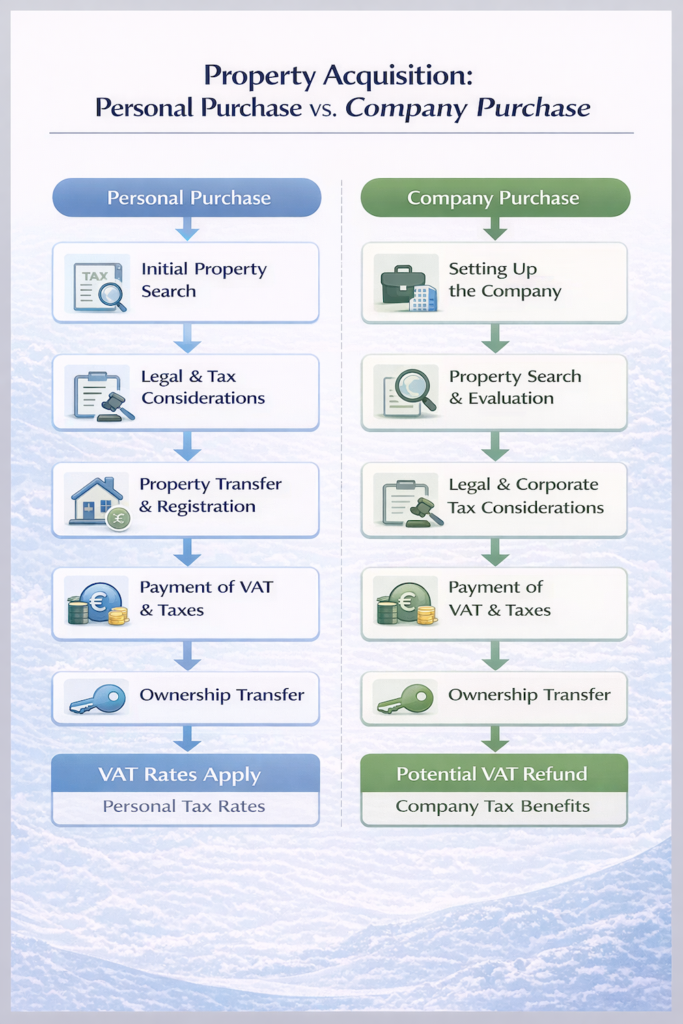
Using your company to buy property in Cyprus can offer significant tax advantages. For commercial properties, the 19% VAT is often deductible or zero-rated. For residential properties intended as a primary residence, the VAT rate can be reduced to 5%. The process involves standard due diligence and a notary transfer, and the company can also benefit from deducting property depreciation against its taxable profits, an advantage not available to individual buyers. Leading agencies like our strategic partner DOM real estate can provide expert guidance on this process.
Cyprus Real Estate Market Forecast for 2026
According to recent market analysis from firms like CBRE, property prices in high-demand areas like Limassol are projected to rise by 5-7% in 2026, fueled by the continuous influx of technology companies and international professionals. For those looking at yields, it is possible to invest in Cyprus real estate and achieve rental returns of up to 6% in prime locations.
Expert’s Edge: Oliver Bennett’s Insider Guide to Avoiding Common Pitfalls
“Foreign entrepreneurs often succeed by embracing local partnerships but fail when they underestimate the pace of local bureaucracy. Preparation and patience are your greatest assets.” – Oliver Bennett, Cyprus Business & Relocation Specialist.
Mistake 1: Underestimating the ‘Siga Siga’ Pace of Bureaucracy
‘Siga siga’ translates to ‘slowly, slowly,’ and it’s a philosophy that permeates many administrative processes here. A realistic approach is to buffer all official timelines by at least 50%. What you expect to take two weeks may well take four, so plan accordingly to avoid frustration and project delays.
Mistake 2: Navigating Banking Due Diligence Unprepared
Cypriot banks are extremely diligent due to strict EU anti-money laundering regulations. They will reject applications with incomplete KYC packages or vague business plans without hesitation. Prepare a comprehensive file with all required documents, a clear business model, and proof of funds before you even approach a bank.
Mistake 3: Neglecting Local Networking and Cultural Nuances
Business in Cyprus is built on relationships and trust. Trying to operate in isolation is a common mistake. Join local chambers of commerce, attend industry events, and invest time in building connections. Cypriots value personal interactions, and skipping this step can cause potential deals and partnerships to stall indefinitely.
Mistake 4: Ignoring a Clear Substance Strategy (Office & Staff)
A company with no physical presence or local employees risks being classified as a shell company by international tax authorities, jeopardizing its favorable tax status. From day one, develop a clear strategy for substance. This means leasing a real office (not just a P.O. box) and hiring local staff as your business grows.
Beyond the Launch: Annual Compliance & Growth
Your Annual Compliance Checklist
Filing Annual Returns & Financial Statements (Audit)
Every Cypriot company must file an annual return (form HE32) with the Registrar and submit audited financial statements to the tax authorities. The deadline for tax filing is typically December 28th of the following year. An audit is required for most companies, except for very small ones with turnover under €70,000.
Paying the Annual Company Levy
The fixed €350 annual levy must be paid to the Registrar of Companies by the 30th of June each year to keep the company in good standing.
Maintaining Proper Accounting Records
Companies are legally required to maintain proper accounting books and records for at least six years. Financial statements must be prepared in accordance with International Financial Reporting Standards (IFRS).
Finding Local Partners, Accelerators, and Support Networks
Engage with local organizations like the Cyprus Chamber of Commerce and Industry or tech accelerators such as CYFA (Cyprus Investment Funds Association) for invaluable mentorship, networking opportunities, and access to local market insights.
Planning Your Exit Strategy: Selling or Closing a Cyprus Company
It is wise to plan your exit strategy from the beginning. Gains from selling the shares of a Cyprus company are generally tax-exempt. If you decide to close the business, the process involves a formal liquidation procedure, which can cost between €500 and €2,000 and take several months to complete.
Frequently Asked Questions (FAQ)
Can a foreigner own 100% of a Cypriot company?
Yes, absolutely. Cypriot law places no restrictions on foreign ownership for Private Limited Companies (LTDs), allowing for 100% foreign shareholding.
What is the minimum share capital for a Cyprus LTD?
Legally, the minimum share capital is just €1. However, it is common practice to establish a company with a nominal share capital of at least €1,000 to enhance its credibility with banks and business partners.
Is a physical office in Cyprus mandatory for tax residency?
While not strictly mandatory in all cases, a physical office is highly recommended to establish and prove economic substance. For initial operations, a virtual office may suffice, but a real office strengthens your tax residency position significantly.
How difficult is it to open a corporate bank account in Cyprus?
The difficulty is moderate. The process is straightforward but requires meticulous preparation of KYC documents and a solid business plan. With proper documentation, it typically takes two to four weeks.
Can I manage my Cyprus company while living abroad?
Yes, it is possible to manage your company remotely. However, you must ensure that the company complies with local substance requirements and that its management and control are exercised from Cyprus to maintain its tax residency status.
How does the Non-Dom status work for business owners?
The Non-Dom status exempts an individual’s worldwide dividend and interest income from taxation in Cyprus. To qualify, you must become a Cyprus tax resident (by spending at least 60 days a year in Cyprus) and prove you were not domiciled there by origin.