
- Gifting vs. Selling vs. Inheritance: A Strategic Comparison
- The Core Benefit: Transfer Fee Exemptions for Family Gifts in 2026
- Full Exemption: Gifting to Spouses, Parents & Children
- Reduced Rate: Gifting to Third-Degree Relatives
- Who Qualifies as a ‘Family Member’ for Tax Purposes?
- The Step-by-Step Procedure for Gifting Property in Cyprus
- Step 1: Legal Due Diligence & Property Valuation
- Step 2: Drafting the Deed of Gift (Δωρητήριο Έγγραφο) with a Lawyer
- Step 3: Stamping the Deed at the Tax Department
- Step 4: Submission to the District Lands Office (DLO)
- Step 5: Issuance of New Title Deeds
- Required Documentation Checklist (For Donor & Recipient)
- Full Cost Analysis: All Taxes & Fees for Gifting Property in 2026
- Land Registry Transfer Fees (The Primary Cost)
- Stamp Duty on the Deed of Gift
- Capital Gains Tax (CGT): Is It Payable on Family Gifts?
- The 0.4% Levy (Defence Fund): Does it Apply to Gifts?
- Critical Pitfalls & How to Avoid Them (Legal & Financial Traps)
- Risk 1: Cyprus’s “Forced Heirship” Rules Overriding a Gift
- Risk 2: Gifting a Property with an Existing Mortgage
- Risk 3: Implications for Non-EU Citizens & Residency Status
- Risk 4: Tax Consequences in the Recipient’s Home Country (e.g., UK, USA)
- Strategic Alternatives to Gifting for Estate Planning
- Cyprus Wills & Probate (Pros and Cons vs. Gifting)
- The “Zero Inheritance Tax” Advantage in Cyprus Explained
- Holding Property Through a Cyprus Company
- Using a Cyprus International Trust (CIT) for Complex Family Assets
- 2026 Market Outlook & Strategic Timing
- Forecast: Potential Changes to Tax Laws & Fees
- How Market Valuations Impact Your Gifting Costs
- Comprehensive FAQ on Cyprus Property Gifting
- Final Checklist & Next Steps
Written and reviewed by Oliver Bennett, a Cyprus resident with over 16 years of direct experience in the island’s real estate market. As the founder of the Cyprus Sunset blog, I’ve personally guided numerous families through the intricacies of property transfers. My goal with this guide is to demystify the process of how to gift property in Cyprus, showing how a correctly timed gift can secure your family’s wealth and streamline future succession.
Gifting vs. Selling vs. Inheritance: A Strategic Comparison
A question I get almost weekly is whether it’s better to gift a property, sell it to a relative for a nominal fee, or simply leave it as part of an inheritance. To be frank, the best path depends entirely on your goals for control, cost, and timing. Here’s a straightforward comparison based on the current 2026 regulations to help you decide.
| Feature | Gifting | Selling (to family) | Inheritance |
| Transfer Time | Fast: Typically 2–6 weeks | Moderate: Typically 4–8 weeks | Slow: 6–18+ months due to probate |
| Immediate Costs | Largely exempt for first-degree relatives | Full transfer fees + Stamp Duty apply | Probate fees and potential legal costs |
| Capital Gains Tax (Donor) | None, if a genuine gift | Possible on any declared profit | None for the deceased’s estate |
| Control (Donor’s lifetime) | Immediate loss of ownership and control | Immediate loss of ownership and control | Full control retained until death |
| Simplicity | High, especially for direct family | Medium, involves a sale agreement | Lower, requires formal will and probate process |
The Core Benefit: Transfer Fee Exemptions for Family Gifts in 2026
The single most compelling reason to gift property in Cyprus is the significant exemption from Land Registry transfer fees when dealing with close family members. This isn’t a small discount; it’s a major financial incentive designed to facilitate inter-family wealth management. The process ensures that the property ownership in Cyprus can be passed down efficiently.
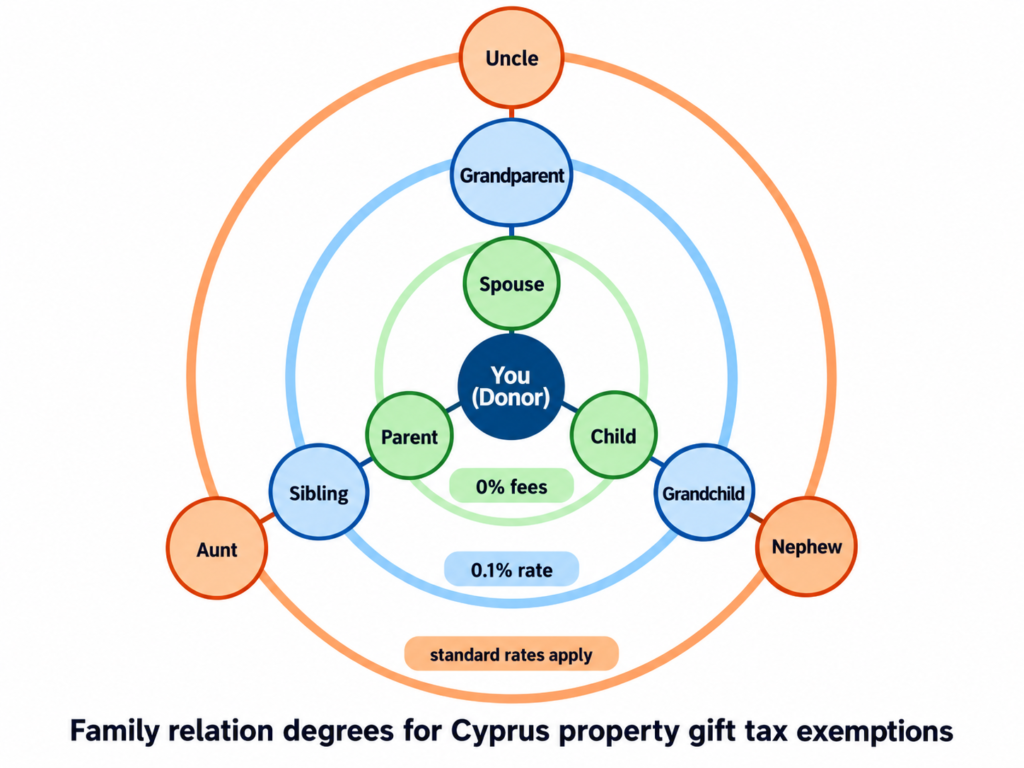
Full Exemption: Gifting to Spouses, Parents & Children
“The complete waiver of transfer fees for gifts between first-degree relatives is the single most powerful estate planning tool in Cyprus law. For a €500,000 property, this is an immediate saving of €40,000. Acting on this can be a game-changer for family wealth preservation.” — Oliver Bennett, Founder of Cyprus Sunset
Reduced Rate: Gifting to Third-Degree Relatives
When you gift property to relatives such as siblings, grandparents, or grandchildren (classified as up to the third degree), you don’t get a full exemption, but you benefit from a substantially reduced transfer fee. Instead of the standard progressive rates, the fee is calculated at a flat 0.1% on the property’s market value. This still represents a massive saving compared to a regular sale.
Who Qualifies as a ‘Family Member’ for Tax Purposes?
The Step-by-Step Procedure for Gifting Property in Cyprus
Navigating the property transfer in Cyprus is a structured process. From my experience, as long as you follow these steps methodically with professional guidance, it is quite manageable.
Step 1: Legal Due Diligence & Property Valuation
Before any documents are drafted, your lawyer must perform crucial due diligence. This involves checking the original title deed for any mortgages, liens, or other encumbrances that could block the transfer. Concurrently, an official valuation of the real estate is obtained from the Land Registry to establish the property’s current market value, which forms the basis for calculating any applicable fees and duties.
Step 2: Drafting the Deed of Gift (Δωρητήριο Έγγραφο) with a Lawyer
A licensed advocate must prepare the Deed of Gift. This legal document formally declares your intention to gift the property, identifies the donor and recipient, and provides a complete legal description of the asset. It must be signed by both parties. It’s a critical document to correctly transfer a property.
Step 3: Stamping the Deed at the Tax Department
Once signed, the Deed of Gift must be taken to the Tax Department to be stamped. This is where you pay the applicable Stamp Duty. The process is swift, but it’s an essential prerequisite before you can approach the Land Registry.
Step 4: Submission to the District Lands Office (DLO)
With the stamped Deed of Gift and all other required documentation in hand, you or your legal representative will submit the complete application file to the District Lands Office (DLO) in the district where the property is located. The DLO officials will review the file to ensure all legal requirements are met.
Step 5: Issuance of New Title Deeds
After the DLO approves the application, the property ownership is officially updated in the Land Register. A new Title Deed is issued in the name of the recipient (the donee), finalizing the transfer. The asset has now officially been transferred.
Required Documentation Checklist (For Donor & Recipient)
Based on my experience helping families, having these documents ready from the start saves a lot of time.
Donor Documents
- Original Title Deed for the property
- Certified copy of Passport or National ID card
- Proof of tax clearance from the Tax Department
- The signed and stamped Deed of Gift
- Receipt of payment for any outstanding property taxes
Recipient Documents
- Certified copy of Passport or National ID card
- Proof of residential address (e.g., utility bill)
- Cyprus Tax Identification Number (TIN), if available
- Signed affidavit confirming the acceptance of the gift
Full Cost Analysis: All Taxes & Fees for Gifting Property in 2026
Let’s break down the real costs involved, so there are no surprises. While the main transfer fee is often waived, there are other smaller costs to consider for any property transfer in Cyprus.
Land Registry Transfer Fees (The Primary Cost)
This is where the biggest savings are. The fee is calculated on the property’s market value on the date you transfer a property.
| Relationship to Donor | Fee Rate | Example on a €300,000 Property |
| Spouse / Parent / Child | 0% | €0 |
| Sibling / Grandparent / Grandchild | 0.1% | €300 |
| Other Relative / Non-relative | Standard progressive rates | €13,500 (calculated at 3% on the first €85,000, 5% on the next €85,000, and 8% on the remaining €130,000) |
Stamp Duty on the Deed of Gift
Stamp Duty is payable on the Deed of Gift contract itself. The rate is calculated on the property’s value: 0.15% for values up to €170,860 and 0.2% for any amount above that, but it is importantly capped at a maximum of €20,000. For most gift transactions, this cost is relatively minor.
Capital Gains Tax (CGT): Is It Payable on Family Gifts?
No. A significant benefit of gifting is that Capital Gains Tax is not triggered for the donor, provided it is a genuine gift and no money or other consideration changes hands. The property’s value must be transferred completely without any form of payment for this to apply.
The 0.4% Levy (Defence Fund): Does it Apply to Gifts?
This levy, which applies to the sale of real estate, does not apply to a gift transaction between qualifying family members. This is another small but welcome cost-saving benefit when you gift property in Cyprus.
Critical Pitfalls & How to Avoid Them (Legal & Financial Traps)
I’ve seen a few families run into trouble by overlooking these critical points. A smooth process is all about anticipating the risks.
Risk 1: Cyprus’s “Forced Heirship” Rules Overriding a Gift
Even after you gift a property, Cyprus’s “forced heirship” laws can come into play upon your death. These rules dictate that a certain portion of your estate must go to your children or spouse, and a lifetime gift can sometimes be “clawed back” into the estate to satisfy these shares. It’s a complex area, and I strongly recommend reading our detailed guide on Cyprus Inheritance Law & Forced Heirship Explained for more clarity.
Risk 2: Gifting a Property with an Existing Mortgage
You cannot simply transfer a property that has an outstanding mortgage. The mortgage is a legal encumbrance registered against the title deed. Before the gift can proceed, the mortgage must either be fully paid off, or you must obtain formal written consent from the lending bank to transfer the property and potentially the loan to the new owner.
Risk 3: Implications for Non-EU Citizens & Residency Status
If the recipient is a non-EU citizen, they generally require permission from the Council of Ministers to acquire immovable property. While this is often a formality for a small apartment or single house, it’s a procedural step that cannot be skipped. Furthermore, gifting a property does not automatically grant the recipient any residency rights.
Risk 4: Tax Consequences in the Recipient’s Home Country (e.g., UK, USA)
While the gift may be tax-free in Cyprus, the recipient’s country of tax residence might view it differently. For example, some countries may treat the received gift as income, or it might have implications for their own inheritance tax planning. Cross-border tax advice is absolutely essential to avoid costly surprises for the recipient down the line.
Strategic Alternatives to Gifting for Estate Planning
Gifting is powerful, but it’s not the only tool. Depending on your goals—especially if you have a larger portfolio or complex family situation—one of these alternatives might be a better fit.
Cyprus Wills & Probate (Pros and Cons vs. Gifting)
Using a will allows you to retain full control and use of your property until your death. The main downside is that the property must go through the probate process, which can take many months and incur legal fees, delaying the transfer to your heirs.
The “Zero Inheritance Tax” Advantage in Cyprus Explained
Cyprus is highly attractive because it has no inheritance or succession tax. This means your heirs will not be taxed on the value of the real estate they inherit. However, this doesn’t eliminate the need for probate, which is a legal process with its own timeline and costs before the asset can be transferred.
Holding Property Through a Cyprus Company
For those with multiple properties, holding them within a Cyprus company can be an effective estate planning tool. Instead of transferring the properties, you simply transfer the company shares to your heirs, which is a much simpler and faster process. This structure can offer enhanced privacy and liability protection, but it does come with annual compliance and accounting costs. This is a common strategy for serious real estate investment in Cyprus.
Using a Cyprus International Trust (CIT) for Complex Family Assets
A Cyprus International Trust is the gold standard for high-net-worth individuals and complex family structures. By placing your property and other assets into a trust, you separate legal ownership from beneficial enjoyment. This provides supreme asset protection from creditors, bypasses forced heirship rules, and allows for highly flexible and confidential succession planning.
2026 Market Outlook & Strategic Timing
Forecast: Potential Changes to Tax Laws & Fees
The Cyprus government views family property transfers as a cornerstone of social stability, so the core gift exemptions are unlikely to face drastic changes. However, ancillary taxes and administrative fees are always subject to review. My advice is to act based on the solid, known benefits available today rather than speculating on future changes.
How Market Valuations Impact Your Gifting Costs
A rising real estate market is a double-edged sword. While it increases the value of the asset being transferred to your loved one, it also increases the basis for calculating Stamp Duty. Even with exempt transfer fees, a higher valuation means a slightly higher ancillary cost, though this is usually a small price for transferring a more valuable asset.
Comprehensive FAQ on Cyprus Property Gifting
Here are quick answers to the most common questions I hear from clients.
Can I gift a property to a non-EU family member?
Yes, you can. However, the non-EU recipient must apply for and receive permission from the Council of Ministers to acquire the property. This is usually a straightforward process for a single residential property but is a mandatory legal step.
What happens if I gift only a share of my property?
This is quite common, especially between spouses. The same rules apply proportionally. For example, if you gift a 50% share of your property to your child, that 50% share will be transferred with a 0% transfer fee. All calculations are based on the value of the share being transferred.
Are there any tax implications for me (the donor) after gifting?
Generally, no. As long as it is a pure gift with no payment or consideration received, there is no Capital Gains Tax in Cyprus for you. The property is simply removed from your asset list, and the new property ownership in Cyprus begins with the recipient.
How long does the entire gifting process take?
For a straightforward case with no mortgage and all documents in order, the entire process, from drafting the deed to the new title being issued, typically takes between two and six weeks. Delays can occur if paperwork is missing or if there are complications with the property’s legal status.
Is it better to gift property now or leave it as an inheritance?
Gifting provides certainty, avoids the lengthy and sometimes costly probate process, and allows your family member to benefit from the property during your lifetime. Leaving it as an inheritance means you retain control until death. If your priority is a quick, clean transfer that avoids future bureaucracy, gifting is often superior.
Can the recipient sell the gifted property immediately?
Yes. Once the new title deeds are issued in their name, the recipient becomes the full legal owner and has the right to sell the property. They should be aware, however, that they will be liable for Capital Gains Tax on any profit made from the sale.
Can a Deed of Gift be revoked?
Revoking a Deed of Gift is extremely difficult and only possible in very limited circumstances, such as proven fraud, duress, or undue influence at the time of signing. For all practical purposes, a gift should be considered a final and irrevocable act to transfer a property.
Final Checklist & Next Steps
If you’re considering this path, here is your action plan to ensure a smooth journey.
Your 4-Point Action Plan
- Verify Eligibility: Confirm with a lawyer that your family relationship qualifies for the 0% or 0.1% transfer fee rate.
- Gather Your Documents: Use the checklist above to assemble all necessary paperwork for both the donor and recipient.
- Get a Professional Valuation: Obtain an up-to-date valuation from the Land Registry to understand the basis for any costs.
- Schedule a Consultation: Speak with an expert to review your specific situation and map out the process.
The journey of transferring property to a loved one is more than a legal transaction; it’s a legacy-defining move. If you are exploring a family property transfer and want an opinion grounded in 16 years of on-the-ground experience, I’m always here to help you navigate the options and point you in the right direction.