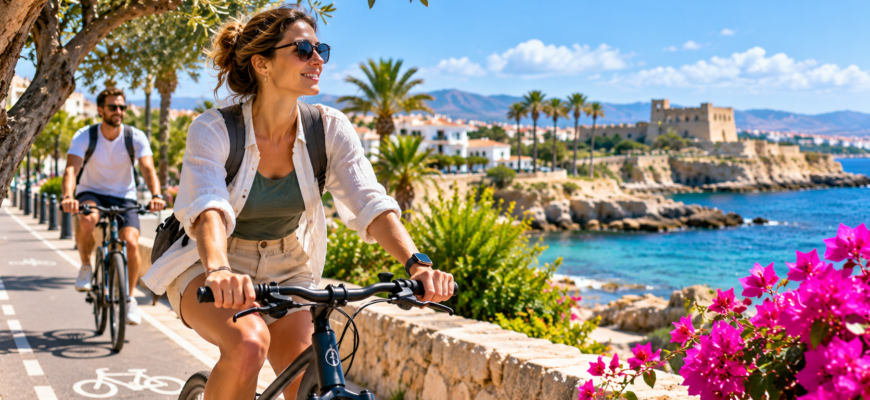
- The Short Answer: Is Daily Cycling in Cyprus Realistic in 2026?
- The Cyprus Cycling Experience: A 2026 Overview for Residents & Visitors
- The Pros vs. Cons: A Balanced Look at Daily Bike Commuting
- The Upside: Why You’ll Love It
- The Reality Check: Key Challenges for 2026
- The Real Estate Advantage: Why Cyclability Boosts Property Value in 2026
- How “15-Minute Cities” are Reshaping Cyprus’s Urban Landscape
- Calculating the “Lifestyle ROI” of a Bike-Friendly Home
- Best Cycling Routes in Cyprus for 2026: From Coastal Paths to Mountain Trails
- Commuter Focus: Practical Routes in Nicosia & Limassol
- Coastal Cruising: The Limassol to Paphos Seafront Paths
- Mountain Challenge: Road & MTB Routes in the Troodos Mountains
- Nature Immersion: Exploring the Akamas Peninsula
- Gearing Up: Your 2026 Guide to Bicycles & Equipment in Cyprus
- E-Bikes: The Ultimate Solution for Cyprus’s Hills and Heat?
- Bicycle Rentals and Services: What You Need to Know
- Essential Safety Gear & Local Laws
- A Commuter’s Guide to Cycling Infrastructure & Safety
- The State of Bike Lanes in Major Cities (2026 Report Card)
- Defensive Cycling Techniques for Cypriot Roads
- Your Practical Cycling Calendar: A Month-by-Month Strategy
- The “Golden Months”: Autumn & Spring (Sep-Nov, Mar-May)
- Surviving the Summer: Early Morning & Evening Ride Strategies (Jun-Aug)
- Winter Riding: Preparing for Rain and Shorter Days (Dec-Feb)
- The Financials: Cycling vs. Car Ownership (2026 Cost Analysis)
- Initial Investment: A Realistic Budget for Your Bike and Gear
- Government Incentives & E-Bike Subsidies: What to Expect in 2026
- Insider Tips from a 16-Year Resident
- My Journey: How I Integrated Cycling into My Cyprus Life
- 3 Common Mistakes New Expat Cyclists Make
- The Unwritten Rules of the Road You Won’t Find in a Guidebook
- Frequently Asked Questions (FAQ)
The Short Answer: Is Daily Cycling in Cyprus Realistic in 2026?
Yes, daily cycling in Cyprus is entirely realistic for many residents, provided you approach it with the right bike, timing, and choice of route. The island’s compact coastal cities and steadily improving paths make cycling in Cyprus practical for daily commuting, especially for trips under 10 kilometers. The main challenges remain the summer heat, often exceeding 35°C, and noticeable gaps in dedicated bike lanes once you leave central districts. My verdict is that the benefits far outweigh the hurdles.
“Yes, with the right strategy and equipment, daily cycling in Cyprus is not only realistic but transformative. From my experience, it connects you to the island in a way a car never can. However, you must be prepared for the distinct challenges of heat and infrastructure. Here’s the breakdown…” — Oliver Bennett, 16-year Cyprus Resident & Cyclist.
The Cyprus Cycling Experience: A 2026 Overview for Residents & Visitors
The Cyprus cycling experience is a unique blend of sun-drenched coastal rides, challenging mountain terrain, and year-round accessibility. For residents, a bicycle becomes a practical tool for short commutes and daily errands, cutting through city traffic. For visitors enjoying their holidays in Cyprus, renting a bike is an excellent way to explore beyond the tourist hotspots. The weather is ideal for Cyprus cycling from October through May, with terrain varying from perfectly flat seafront promenades in Limassol to the demanding climbs of the Troodos mountains. The 2026 infrastructure network includes more dedicated paths than ever before, yet my 16-year perspective confirms that summer conditions and road sharing remain key factors in your daily cycling decisions.
The Pros vs. Cons: A Balanced Look at Daily Bike Commuting
The Upside: Why You’ll Love It
The cost savings become immediately apparent, especially with fuel prices consistently above €1.60 per litre. Health benefits are a major plus, integrating consistent, moderate exercise into your daily routine during the island’s long, mild seasons. Beating city traffic is a genuine advantage, significantly shortening your effective commute time in congested areas of Limassol and Nicosia. My favorite part, however, is discovering Cyprus at a slower pace; this mode of travel reveals charming hidden neighborhoods, quiet cafes, and stunning sea views that are simply invisible when you travel by car.
The Reality Check: Key Challenges for 2026
The summer heat is non-negotiable and demands a strategic approach, typically riding before 8 a.m. or after 6 p.m. Infrastructure gaps remain a reality; Limassol’s seafront path is a fantastic, continuous route, but many residential streets in cities like Paphos still lack clear markings or dedicated lanes. The hilly terrain in many areas makes a strong case for E-Bikes, particularly those with mid-drive motors that handle inclines more efficiently. Finally, navigating the local driving culture requires a defensive mindset; drivers often overtake with little clearance, making bright clothing and powerful lights essential safety tools.
The Real Estate Advantage: Why Cyclability Boosts Property Value in 2026
For property investors, cyclability is no longer a niche amenity but a key factor influencing real estate decisions in Cyprus. Access to daily cycling routes directly reduces household transport costs and significantly improves the quality of life, particularly for expat families. My experience shows that districts with continuous, safe cycling paths see stronger rental demand and more stable resale values. This lifestyle feature adds a tangible return on investment, making it a critical consideration for anyone looking to invest in Cyprus real estate.
How “15-Minute Cities” are Reshaping Cyprus’s Urban Landscape
The “15-minute city” concept, where housing, shops, and schools are clustered within a short walk or bike ride, is visibly influencing urban planning in Cyprus. New developments, especially in areas like western Limassol and parts of Larnaca, are designed around this philosophy. This layout directly rewards residents who opt for bicycles over cars for daily errands, making a car-light lifestyle not just possible but preferable, and thus boosting the long-term value of properties in these zones.
Calculating the “Lifestyle ROI” of a Bike-Friendly Home
Let’s talk numbers. A property located within 800 meters of a continuous cycle path can realistically save a household between €1,200 and €1,800 annually in fuel, parking, and vehicle wear-and-tear. More importantly, this proximity dramatically raises the property’s appeal for long-term rentals, especially among European tenants accustomed to a cycling culture. This “Lifestyle ROI” is a powerful, though often overlooked, asset when you decide to buy property in Cyprus.
Best Cycling Routes in Cyprus for 2026: From Coastal Paths to Mountain Trails
Commuter Focus: Practical Routes in Nicosia & Limassol
In Nicosia, the Pedieos River linear park path provides a green, car-free corridor linking residential areas like Strovolos to the city’s old town in under 20 minutes. For commuters in Limassol, the 10 km seafront route is the main artery, running from the old port past the new marina, and is perfectly suited for all types of bicycles, including road bikes and hybrids. These cycling routes are lifelines for daily travel.
Coastal Cruising: The Limassol to Paphos Seafront Paths
The coastal path from the Limassol marina towards Paphos offers sections of continuous promenade covering over 35 km with minimal elevation gain. It’s a stunning ride best enjoyed from October to May. My pro tip: start early in the morning to avoid the densest tourist foot traffic and catch the beautiful sunrise over the Mediterranean, a highlight of any holidays in Cyprus.
Mountain Challenge: Road & MTB Routes in the Troodos Mountains
For serious cyclists, the Troodos mountains are the ultimate playground. The classic road climb from Platres to the peak of Mount Olympus reaches an altitude of 1,950 meters, testing even seasoned riders. Both road and mountain bikers should target March–May and September–November for these cycling routes, as the cooler air provides better performance and the visibility is crystal clear.
Nature Immersion: Exploring the Akamas Peninsula
The rugged, unpaved tracks winding through the Akamas Peninsula demand a mountain bike or a capable gravel model. The iconic cycling route from Lara Bay to the Baths of Aphrodite covers approximately 22 km of raw natural beauty. This ride is most comfortable and visually spectacular in the spring when the landscape is lush and green.
Gearing Up: Your 2026 Guide to Bicycles & Equipment in Cyprus
When it comes to bicycles in Cyprus, choosing the right type is crucial for a positive experience. The market for both purchasing and renting is well-developed, offering everything from high-end road bikes to practical e-bikes.
E-Bikes: The Ultimate Solution for Cyprus’s Hills and Heat?
My straightforward answer is yes, for most people, an e-bike is the best all-around choice. It flattens the island’s challenging hills and makes cycling in the summer heat manageable by reducing physical exertion.
| Bike Type | Avg. Cost (€) | Hill Performance | Maintenance | Heat Suitability |
| E-Bike | 1,800–3,500 | Excellent | Medium (Battery/motor checks) | High (Motor assist is a game-changer) |
| Road Bike | 800–2,200 | Good (Requires fitness) | Low | Medium (Lightweight but requires full effort) |
| Hybrid | 600–1,400 | Average | Low | Medium (Versatile but can be heavy on hills) |
Bicycle Rentals and Services: What You Need to Know
For those not ready to buy, bicycle rentals are plentiful. Expect to pay around €15–€25 for a daily rental, with weekly rates dropping to €70–€110. You’ll find reliable rental shops near Limassol marina, Paphos harbor, and within Nicosia’s old town. When renting, always inspect the tire tread and brake pads, and if you’re getting an e-bike, ask about the battery’s age and expected range.
Essential Safety Gear & Local Laws
Let’s be clear on safety. While helmets are only legally mandatory for riders under 18, I consider them non-negotiable for all ages. Front and rear lights are required by law at dusk and in low visibility. A high-quality D-lock or chain lock and a portable frame pump should be part of every cyclist’s standard kit. Remember, traffic laws treat bicycles as vehicles, which means you ride with the flow of traffic, obey all signals, and use hand signals for turns.
A Commuter’s Guide to Cycling Infrastructure & Safety
An honest look at cycling safety and infrastructure is essential. While progress has been made, the experience varies significantly from city to city. Understanding these differences is key to safe and enjoyable Cyprus cycling.
The State of Bike Lanes in Major Cities (2026 Report Card)
Limassol earns the highest score due to its continuous waterfront lane and a growing network of inland connectors. Nicosia offers good coverage within the historic city walls but has fragmented links to its suburbs. Paphos and Larnaca are catching up, but for now, cyclists in residential zones must primarily rely on sharing the road with vehicles.
Defensive Cycling Techniques for Cypriot Roads
My top three rules for staying safe on the road: First, always maintain at least one meter of space from parked cars to avoid being “doored.” Second, use bright, visible clothing and daytime running lights to maximize your presence. Third, on two-lane roads where there isn’t enough space for a car to pass you safely within the lane, “claim the lane” by riding closer to the center to discourage dangerous overtaking.
Your Practical Cycling Calendar: A Month-by-Month Strategy
The “Golden Months”: Autumn & Spring (Sep-Nov, Mar-May)
These are the peak seasons for cycling in Cyprus. Stable temperatures ranging from 18°C to 26°C and minimal wind create perfect conditions for both commuting and long recreational rides. The entire island is your playground during these months.
Surviving the Summer: Early Morning & Evening Ride Strategies (Jun-Aug)
Summer riding is all about timing. Start your rides by 6:30 a.m. to finish before the heat intensifies, or wait until after 7 p.m. for cooler evening air. Hydration is critical; I carry 1.5 litres of water for every hour of riding and plan routes that include shaded rest stops or coastal breezes.
Winter Riding: Preparing for Rain and Shorter Days (Dec-Feb)
Winter is very mild, but you need to prepare for occasional showers and shorter daylight hours. A lightweight rain jacket and reflective tape are sufficient for the rain. Daylight shortens to about nine hours, so powerful front and rear lights become essential for every single ride, not just at dawn or dusk.
The Financials: Cycling vs. Car Ownership (2026 Cost Analysis)
The financial argument for switching to a bicycle for daily commuting is compelling. When you break down the numbers, the savings are substantial, freeing up capital that could be better used elsewhere—perhaps towards a property investment.
| Expense | Annual Car Ownership (€) | Annual E-Bike Commuting (€) |
| Fuel/Electricity | 1,650 | 85 |
| Insurance | 420 | 0 |
| Road Tax | 150 | 0 |
| Maintenance | 380 | 120 |
| Depreciation | 1,800 | 250 |
| Total Annual Cost | 4,400 | 455 |
Based on a 15km daily commute and projected 2026 costs in Cyprus.
Initial Investment: A Realistic Budget for Your Bike and Gear
Let’s set a realistic budget. A dependable e-bike suitable for daily commuting, combined with a quality helmet, lights, and a sturdy lock, will cost between €2,100 and €2,800. I also recommend budgeting an additional €150 for essential home maintenance tools like a floor pump and a basic repair stand.
Government Incentives & E-Bike Subsidies: What to Expect in 2026
The Cypriot government continues to encourage greener transport. Current subsidy schemes offer residents up to €400 towards the purchase of a new e-bike. These programs are updated annually, so I advise checking the latest circular from the Ministry of Transport each January for the most current information.
Insider Tips from a 16-Year Resident
My Journey: How I Integrated Cycling into My Cyprus Life
When I first relocated here in 2010, I assumed a car was essential for everything. For the first two years, it was. Then, as the coastal path in Limassol began to take shape, I started using a bike for short trips. It was a revelation. That 15-minute ride to a meeting replaced a 25-minute drive in traffic and a frustrating search for parking. It fundamentally improved my daily routine and well-being, and I’ve been a daily cyclist ever since.
3 Common Mistakes New Expat Cyclists Make
- Buying the wrong bike. Many buy a heavy, cumbersome city bike, not realizing that even coastal towns have sharp hills. A lightweight hybrid or an e-bike is a much better investment.
- Underestimating hydration. The dry heat means you dehydrate faster than you think. By the time you feel thirsty, you’re already behind. Always drink water proactively.
- Assuming driver awareness. Never assume a driver has seen you, especially at roundabouts. Make eye contact and be prepared to yield, even if you have the right of way.
The Unwritten Rules of the Road You Won’t Find in a Guidebook
Here’s what I’ve learned over the years. Locals often use a quick tap of the horn not as an act of aggression, but as a simple “I’m here” warning—don’t take it personally. A friendly wave when someone yields to you goes a long way in keeping interactions positive. And my most important tip: in villages, it’s common to see children on bikes riding two or even three abreast. Slow down well in advance and give them plenty of space.
Frequently Asked Questions (FAQ)
How do you handle the extreme summer heat when cycling daily?
The key is avoidance and adaptation. Ride during the cooler parts of the day—before 8 a.m. or after 7 p.m. Always carry more water than you think you’ll need, and choose routes that offer shade or a consistent sea breeze, like the coastal paths. On the hottest days, sometimes the best choice is to simply take a rest day.
Is it safe to cycle at night in cities like Limassol or Nicosia?
On well-lit main paths and roads, yes, it is generally safe, provided you have a powerful set of front and rear lights. I recommend a front light of at least 400 lumens. However, I would avoid unlit residential streets and industrial areas late at night due to poor visibility and potential hazards.
Can I take my bicycle on public buses in Cyprus?
Yes, most of the green intercity buses will accept bicycles in the main luggage hold underneath, usually for a small additional fee of around €2-€5. It’s always best to confirm with the driver before you board, especially if the bus looks crowded. City buses are less likely to have space.
Are electric scooters a more practical alternative for short commutes?
Electric scooters are great for very short trips (under 4 km) on flat, smooth ground. However, they lack the range, stability, and hill-climbing performance of a quality e-bike. For anyone facing a varied daily commute, an e-bike is a far more robust and practical solution.
What are the best navigation apps for cycling routes in Cyprus?
For discovering and planning new cycling routes, Komoot and Strava are excellent, with strong local user communities contributing routes and tips. For day-to-day navigation, Google Maps has significantly improved and its cycle-path layer, which was updated in late 2025, is now quite reliable for major urban areas.