
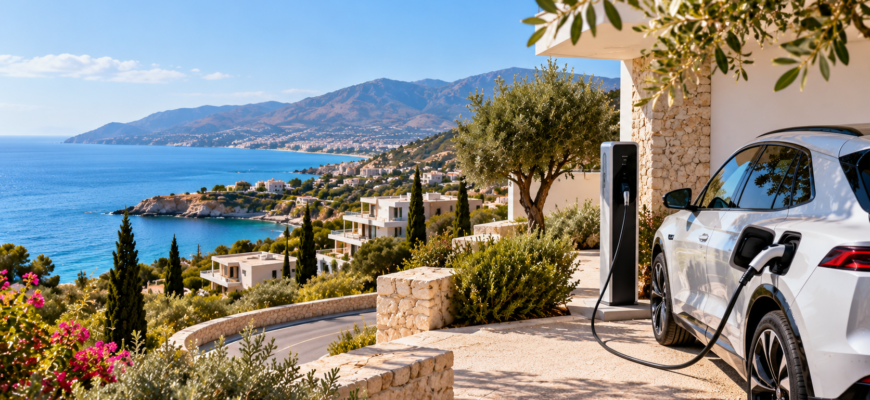
- Electric Cars in Cyprus 2026: An Expert’s Guide for Residents
- Pros and Cons of Owning an Electric Vehicle in Cyprus
- Buying an Electric Vehicle: How it Impacts Your Cyprus Property Choice
- The Financial Reality: 2026 Cost of Ownership Breakdown
- 2026 Cost Comparison: Electric Car vs. Petrol Car in Cyprus
- Cyprus Government Incentives for Electric Cars in 2026
- The Cyprus EV Charging Network Explained: Home & Public
- A Map of EV Charging Stations in Cyprus for 2026
- How EV Charging Works: A Step-by-Step Guide for Cyprus
- Using a Public Charger in Cyprus
- Installing a Home Charger: Your Personal Fuel Station
- Expert Verdict by Oliver Bennett: Real-World EV Life in Cyprus
- The “Cyprus Stress Test”: Real-World Range vs. Official Figures
- Top 3 Mistakes New EV Owners Make in Cyprus (and How to Avoid Them)
- Future-Proofing Your EV Journey: What’s Next for Cyprus?
- Top 3 EV Models Recommended for Cyprus Driving Conditions in 2026
- No Driveway, No Problem? The Future of Apartment Charging in Cyprus
- What Happens to Old EV Batteries? Recycling in Cyprus
- Frequently Asked Questions
As a long-term Cyprus resident and EV driver for several years now, I’ve navigated the exact challenges and opportunities you’re facing. My experience isn’t from a brochure; it’s from daily drives to the supermarket, trips to the Troodos mountains, and helping clients find homes that work with their new electric lifestyle. This guide is built on that real-world data and my personal experience.
Electric Cars in Cyprus 2026: An Expert’s Guide for Residents
The market for electric cars in Cyprus has truly come of age. While the shift started gaining traction around 2020, 2026 marks a clear turning point for both residents and expats considering the switch. As your guide, I, Oliver Bennett, see that government support through the e-kinisi programme remains a powerful motivator, while the network of public charging stations has expanded significantly. The island’s compact geography makes an electric vehicle a practical choice for most, yet the sunny climate and mountainous terrain introduce unique factors you must consider.
A question I get weekly from clients is, “Oliver, is now the right time to get an electric car in Cyprus?” For those who can install a home charger, the answer is an emphatic yes, thanks to lower running costs and zero road tax. However, those depending solely on public charging stations might still find minor inconveniences outside the main cities. My personal transition to an electric vehicle in 2022 proved that with smart property selection, nearly all friction disappears. This is a key part of the modern Cyprus expat blog conversation.
Pros and Cons of Owning an Electric Vehicle in Cyprus
Owning an electric vehicle in Cyprus offers distinct financial and lifestyle benefits, but it’s wise to weigh them against the current limitations. Here’s an honest breakdown based on my experience.
Pros
- Lower Running Costs: Electricity is significantly cheaper than petrol, drastically reducing your monthly “fuel” bill.
- Government Subsidies: Generous grants on the purchase of a new electric car and home charger installation make the initial investment more palatable.
- Reduced Maintenance: With no oil changes, spark plugs, or exhaust systems, annual servicing costs are minimal.
- Quiet & Smooth Ride: The silent, instant torque of an electric motor makes driving in city traffic or on the highway a far more relaxing experience.
- Environmental Benefits: Zero tailpipe emissions contribute to cleaner air, and you pay €0 in annual road tax.
Cons
- Higher Initial Cost: Even with subsidies, the upfront price for most new electric vehicles remains higher than their petrol counterparts.
- Range Anxiety in Mountains: The steep ascent into the Troodos Mountains can reduce range, requiring more careful planning.
- Developing Public Infrastructure: While the network of charging stations is growing, finding an available spot in remote villages can still be a challenge.
- Resale Value Uncertainty: As battery technology evolves, the long-term resale value of current models is still an unknown variable.
- Home Charging Dependency: For maximum convenience and cost savings, having access to a home charging point is almost essential.
Buying an Electric Vehicle: How it Impacts Your Cyprus Property Choice
When you decide to buy an electric vehicle, your property search criteria fundamentally change. It’s no longer just about the number of bedrooms; it’s about your personal “fueling” infrastructure. A villa with a private driveway or covered parking is ideal, allowing for the straightforward installation of a 7 kW wallbox. Many new apartment complexes, anticipating the trend, now include dedicated EV parking bays with pre-installed wiring. For older buildings, retrofitting a home charger can be complex, often requiring EAC (Electricity Authority of Cyprus) approval and extra cabling costs that can approach €1,500.
This is why I now guide every client to treat charger feasibility as a critical part of their real estate search. Prioritizing homes that already support a home charger setup saves you from future headaches and enhances the long-term investment value of your asset. You can explore a curated selection of properties that are EV-friendly on platforms that let you filter by these modern amenities, such as when you buy property in Cyprus.
“Don’t just buy a car; buy an ecosystem. Your property choice is now directly tied to your ‘refueling’ strategy. I always advise clients to factor in charger installation costs and feasibility as a non-negotiable part of their property budget.” — Oliver Bennett, Cyprus Real Estate Expert
The Financial Reality: 2026 Cost of Ownership Breakdown
2026 Cost Comparison: Electric Car vs. Petrol Car in Cyprus
While the initial purchase price for EVs often remains higher in 2026, the substantial savings on fuel, maintenance, and taxes typically result in a lower total cost of ownership over a five-year period. This financial benefit is a cornerstone of any sound Cyprus property investment strategy that includes lifestyle assets.
| Item | Tesla Model 3 (after subsidy) | VW Golf 1.5 TSI |
| Purchase price | €38,000 | €32,000 |
| Annual road tax | €0 | €180 |
| Annual energy/fuel (15,000 km) | €525 | €1,500 |
| Annual maintenance | €180 | €420 |
| 5-year total cost | €41,525 | €46,500 |
Based on an average electricity tariff of €0.35/kWh and a petrol price of €1.50/L.
Cyprus Government Incentives for Electric Cars in 2026
The Cypriot government continues to champion the transition to electric vehicles through its “e-kinisi” grant scheme. The application process is managed online, making it accessible for all residents.
You can find the full eligibility criteria and application forms directly on the official government portal of the Ministry of Transport, Communications and Works.
Key incentives for 2026 include:
- Purchase Grant: Up to €8,000 for purchasing a new battery-electric vehicle (BEV).
- Scrappage Bonus: An additional €2,000 for retiring an old, high-emission petrol or diesel car.
- Home Charger Subsidy: A grant of €600 to help cover the cost of installing a home charging point.
- Road Tax Exemption: A complete exemption from annual road tax (€0) for all all-electric vehicles.
The Cyprus EV Charging Network Explained: Home & Public
A Map of EV Charging Stations in Cyprus for 2026
The public network of EV charging stations in Cyprus has expanded dramatically, transforming the driver experience. The primary operators—Eleport, E-charge, and the Electricity Authority of Cyprus (EAC)—have established a robust infrastructure of charging stations. You’ll find DC fast chargers strategically placed along the main Limassol–Nicosia and Limassol-Paphos highways, as well as in all major coastal towns. While coverage in the Troodos mountain villages and some inland residential zones is still improving, the number of charging stations grows monthly. Finding charging stations is no longer a major hurdle for most journeys.
How EV Charging Works: A Step-by-Step Guide for Cyprus
Navigating the EV charging Cyprus network is simple once you know the basics. Here’s how to handle both public and private charging.
Using a Public Charger in Cyprus
Charging your electric car at a public station is a straightforward process.
- Find a Station & Check Availability: Use an app like PlugShare or the network provider’s specific app (e.g., Eleport) to locate nearby charging stations and see if they are currently in use.
- Authenticate & Connect: Start the session via the mobile app or by tapping a pre-registered RFID card against the reader. Once authorized, plug the cable into your electric car.
- Understand the Cost: Payment is typically on a pay-per-kWh basis. In 2026, expect to pay around €0.35–€0.45/kWh for AC charging and €0.55–€0.65/kWh for DC fast charging.
- Charging Etiquette: A simple but important rule: once your car is sufficiently charged, move it. This frees up the bay for the next EV driver, especially at high-demand fast charging stations.
Installing a Home Charger: Your Personal Fuel Station
Setting up a personal charging station at home is the key to unlocking the full convenience of an electric car.
- Choose Your Charger & Installer: Opt for a “Mode 3” wallbox from a reputable brand and always use a certified electrician for the installation.
- The EAC Approval Process: Your electrician will help you submit a survey application to the EAC to ensure your home’s electricity supply can handle the additional load.
- Installation & Costs: For a standard 7 kW wallbox, budget between €800 and €1,500 for the unit and installation. The process is usually completed in a single day.
- Claiming Your Subsidy: After the installation is complete and certified, you can apply online for the government’s €600 home-charger grant.
As mentioned in the section on property choice, assessing a home’s readiness for this process before you rent property in Cyprus or buy is a crucial step.
Expert Verdict by Oliver Bennett: Real-World EV Life in Cyprus
The “Cyprus Stress Test”: Real-World Range vs. Official Figures
Official range figures from manufacturers are a useful starting point, but they don’t tell the whole story of driving an electric car in Cyprus. The island’s unique conditions provide a real-world “stress test.” Running the air-conditioning on a 35°C summer day will typically reduce your battery’s range by 12–15%. Furthermore, the scenic drive from sea level up to a Troodos village can consume another 20–25% of your battery on the ascent. The good news? You’ll recover a surprising amount of that energy through regenerative braking on the way back down. A car with an official range of 450 km will realistically deliver 300–380 km under typical island conditions.
Top 3 Mistakes New EV Owners Make in Cyprus (and How to Avoid Them)
From my own experience and from speaking with dozens of new EV owners, a few common pitfalls emerge. Avoid them, and your transition will be seamless.
- Relying Only on Public Charging: This is the number one mistake. For daily convenience and the lowest running costs, installing a home charging solution is non-negotiable. Treat public charging stations as a resource for long trips, not for daily use.
- Ignoring Pre-Conditioning: On hot summer days, use the car’s mobile app to cool down the cabin while it’s still plugged in. This uses power from the grid, not your battery, preserving precious range for your drive.
- Misunderstanding Charger Speeds: Don’t expect a fast-food-style top-up from every plug. A 7kW home charger is for overnight charging (6-8 hours), while a 50kW+ DC fast charger is for quick top-ups on the go (20-40 minutes).
Future-Proofing Your EV Journey: What’s Next for Cyprus?
Top 3 EV Models Recommended for Cyprus Driving Conditions in 2026
- Tesla Model 3/Y: Offers a leading combination of range, efficiency, and access to the island’s Supercharger network, backed by established service support.
- Hyundai Ioniq 5 / Kia EV6: These models feature a highly efficient heat pump for better winter performance and ultra-fast 800V charging architecture.
- Skoda Enyaq: A practical and spacious family SUV that offers an excellent balance of range, comfort, and value, especially after applying government incentives. For more insights on island living, our Cyprus Life & Real Estate Blog is a great resource.
No Driveway, No Problem? The Future of Apartment Charging in Cyprus
The lack of a private driveway is a major concern for apartment dwellers, but solutions are emerging. New residential projects from leading agencies like our partners at DOM — Leading Real Estate Agency in Cyprus increasingly include communal charging stations in shared parking areas. Municipalities in Limassol and Nicosia are also piloting on-street charging solutions. For now, fast-charging hubs located within a five-minute drive of most urban apartment districts serve as a viable backup.
What Happens to Old EV Batteries? Recycling in Cyprus
Addressing a common environmental concern, plans are already underway for end-of-life battery management. European regulations mandate that manufacturers are responsible for collecting and recycling old battery packs. Furthermore, a promising “second-life” market is emerging, where used car batteries are repurposed for home solar energy storage, providing continued value and minimizing environmental impact.
Frequently Asked Questions
How long does it really take to charge an electric car in Cyprus?
It depends entirely on the charger. A home charger (7kW) takes 6-8 hours for a full charge overnight. A public AC charger (22kW) takes 2-3 hours. A public DC fast charger (50kW+) can add up to 80% charge in just 20-40 minutes.
Can the Cyprus electricity grid (EAC) handle a mass switch to EVs?
This is a common and valid question. The EAC is actively preparing by rolling out smart-charging programs and upgrading grid infrastructure. The mass adoption of overnight charging during off-peak hours, when electricity demand is low, allows the grid to absorb the additional load without strain.
Is it cheaper to charge an EV at night with EAC’s tariffs?
Absolutely. The EAC offers time-of-use tariffs with significantly lower rates during off-peak hours (typically overnight). By scheduling your electric car to charge after 11 PM, you can reduce your charging costs by approximately 30% compared to daytime peak rates.
Do I need to buy a separate cable for public charging in Cyprus?
Yes, for most AC public charging stations, you will need to use your own Type 2 charging cable, which comes standard with most electric cars sold in Europe. However, the more powerful DC fast chargers always have the cable permanently attached to the unit for your convenience.