

By Oliver Bennett, 16-Year Cyprus Resident & Relocation Expert.
Why Consider Moving to Cyprus in 2026? An Expert’s Perspective
“After 16 years here, I can tell you that moving to Cyprus isn’t just about the Mediterranean views—it’s about building a life with lower taxes, family-friendly communities, and endless sunshine. In 2026, with remote work booming, it’s an ideal spot for a fresh start.” – Oliver Bennett, Cyprus Relocation Expert
Today, Cyprus is far more than a sun-soaked holiday destination; it’s a dynamic hub for professionals and families seeking a blend of modern convenience and a genuinely relaxed Mediterranean lifestyle. Families I work with consistently praise the exceptionally safe environment and the high standard of English-speaking schools. For investors, the growing economy presents compelling opportunities. In 2026, we anticipate steady property value increases in prime areas like Limassol, making a move to Cyprus a timely decision. I’ve personally guided dozens through their relocation, and the universal feedback is that the quality of life upgrade more than justifies the initial logistics. When you’re dreaming of this transition, focus on the tangible benefits: 300+ days of sunshine, a welcoming expat community, and seamless EU access.
Estimate Your 2026 International Moving Costs to Cyprus
Let’s talk numbers, because that’s the first question everyone asks. To give you an immediate, ballpark idea of your international moving costs, I recommend using an interactive estimator. Simply input your current country, your destination city in Cyprus (like Limassol or Larnaca), and the size of your home—whether it’s a cozy 1-bedroom apartment or a spacious 3-bedroom house. This tool provides an instant, non-binding cost forecast for shipping belongings, calculated from current market data. For instance, a typical move from the UK might range from €2,000 to €3,000 for a smaller shipment. Think of it as your first financial sketch—it’s not the final invoice, but it’s an essential starting point for your budget.
Key Factors That Determine Your Final Bill
Shipment Volume (Cubic Meters) vs. Weight
The volume of your goods, measured in cubic meters (m³), is the primary driver of sea freight costs, much more so than weight. A typical 1-bedroom flat might require 10-15 cubic meters of space, which could cost between €1,500-€2,500 for a move from within Europe. While weight is secondary, exceedingly heavy items like a marble table or a piano can incur special handling fees, so it’s wise to measure and weigh everything you plan to ship. In my experience, clients who overestimate their volume slightly are happier than those who underestimate and face surprise charges later.
Origin Country & Distance to Port
It’s simple geography: distance matters significantly. Shipping belongings to Cyprus from the UK is closer and generally averages €2,000-€4,000, while a move from the USA can easily jump to €5,000-€10,000 because of the long transatlantic route. The specific origin port, such as Southampton or New York, also influences the final price. I’ve seen moves from the UAE or Israel cost less than those from Northern Europe due to more direct and shorter Mediterranean shipping lanes.
Type of Service: Door-to-Door vs. Port-to-Port
A door-to-door service, which includes professional packing, pickup from your old home, sea freight, customs clearance, and delivery to your new address, can add 20-30% to the overall cost but removes nearly all logistical headaches. A port-to-port service, where you manage the transportation to and from the docks yourself, can cut costs by €500-€1,000. For families juggling kids, pets, and new jobs, I always recommend the door-to-door option to avoid unnecessary stress upon arrival.
Insurance, Customs Duties, and Surcharges
Comprehensive moving insurance typically costs 1-3% of the total declared value of your goods—this is essential for protecting valuables and breakables. Customs duties are usually waived if you qualify for residency relief, but you must account for potential temporary port fees, documentation charges, and fuel surcharges that fluctuate with global oil prices. It’s prudent to budget an extra €200-€500 for this paperwork. One client saved nearly €1,000 in potential damages by opting for the right insurance policy after I walked them through the risks.
Estimated Shipping Costs to Cyprus (2026 Forecast Table)
| Origin Country | Home Size | Shipping Method | Estimated Cost Range (2026) |
| UK | 1-Bed Apt | LCL (Shared) | €1,800 – €2,500 |
| UK | 3-Bed House | FCL 20ft (Exclusive) | €3,500 – €5,000 |
| USA | 1-Bed Apt | LCL (Shared) | €4,000 – €6,000 |
| USA | 3-Bed House | FCL 20ft (Exclusive) | €7,000 – €10,000 |
| Israel | 1-Bed Apt | LCL (Shared) | €1,200 – €1,800 |
| Israel | 3-Bed House | FCL 20ft (Exclusive) | €2,500 – €4,000 |
| UAE | 1-Bed Apt | LCL (Shared) | €1,500 – €2,200 |
| UAE | 3-Bed House | FCL 20ft (Exclusive) | €3,000 – €4,500 |
These are estimated 2026 shipping costs based on current market trends and are for planning purposes only. Actual prices from movers will vary.
Pro Tips: How to Significantly Reduce Your Moving Costs
The Art of Decluttering: Don’t Pay to Ship What You Don’t Need
Before you pack a single box, be ruthless. Sell, donate, or recycle any items you haven’t used in the last year. One family I helped relocate from Germany cut their required shipping volume by 30% by selling bulky, unused furniture, saving them over €800 on container shipping. Always ask yourself: “What is the replacement cost in Cyprus?” Often, you’ll find that items like generic wardrobes or sofas are cheaper to buy locally than to ship.
Timing Your Move: Peak vs. Off-Peak Season Impact
The international moving industry has a clear peak season: the summer months (June through August). Shipping during this time can increase your rates by 15-20% due to high demand. If your timeline is flexible, aim for the off-peak season (October to March) for potential savings of up to €1,000 on a large move. With tourism in Cyprus expected to be strong in 2026, booking your move well in advance is the key to securing better rates.
DIY Packing vs. Professional Services: A Cost-Benefit Analysis
Packing everything yourself can save you between €300 and €600 in labor costs, but it comes with a risk: movers’ insurance may not cover damage to items you packed yourself. Professional packing ensures everything is properly protected, which is invaluable for fragile or high-value items. A client moving with a collection of antique ceramics opted for pro packing, and it prevented what could have been over €2,000 in claims when the container experienced rough seas.
Shipping Methods Explained: Choosing Between Sea and Air Freight
Option 1: Sea Freight (The Standard Choice)
Shared Container (LCL – Less than Container Load): For smaller moves.
Shared container shipping, or LCL, is your best bet for smaller moves. It consolidates your belongings with others in a single container, making it perfect for volumes between 5 and 15 cubic meters. Expect costs around €100-€150 per cubic meter, with a transit time of 4-6 weeks. It’s the go-to, cost-effective solution for apartment-sized relocations.
Exclusive Container (FCL – Full Container Load): For larger family homes.
FCL gives you exclusive use of a 20ft or 40ft container, ideal for shipments of 20 cubic meters or more—enough for a typical three-bedroom family home. While the upfront price of €3,000-€6,000 is higher, it offers greater security, a slightly faster transit time as there’s no consolidation delay, and is more cost-effective per cubic meter for large volumes. I used FCL for my own family’s move; it’s the most reliable method for a large quantity of belongings.
Option 2: Air Freight (The Express Option)
When to Use Air Freight: For urgent, high-value, or small shipments.
Air freight is the express courier of international moving. It’s best suited for small, essential shipments under 100kg that you need immediately upon arrival. Expect costs of €5-€10 per kilogram, with delivery in just 1-2 weeks. It is prohibitively expensive for furniture but perfect for shipping work computers, important documents, or a box of sentimental items that you can’t live without.
| Metric | Sea Freight | Air Freight |
| Typical Cost | €100-€150 per m³ | €5-€10 per kg |
| Transit Time | 4-6 weeks | 1-2 weeks |
| Best For (Volume) | Large household moves, furniture, vehicles | Small boxes, urgent items, valuables |
Your Step-by-Step Timeline for Moving to Cyprus (The Complete 2026 Plan)
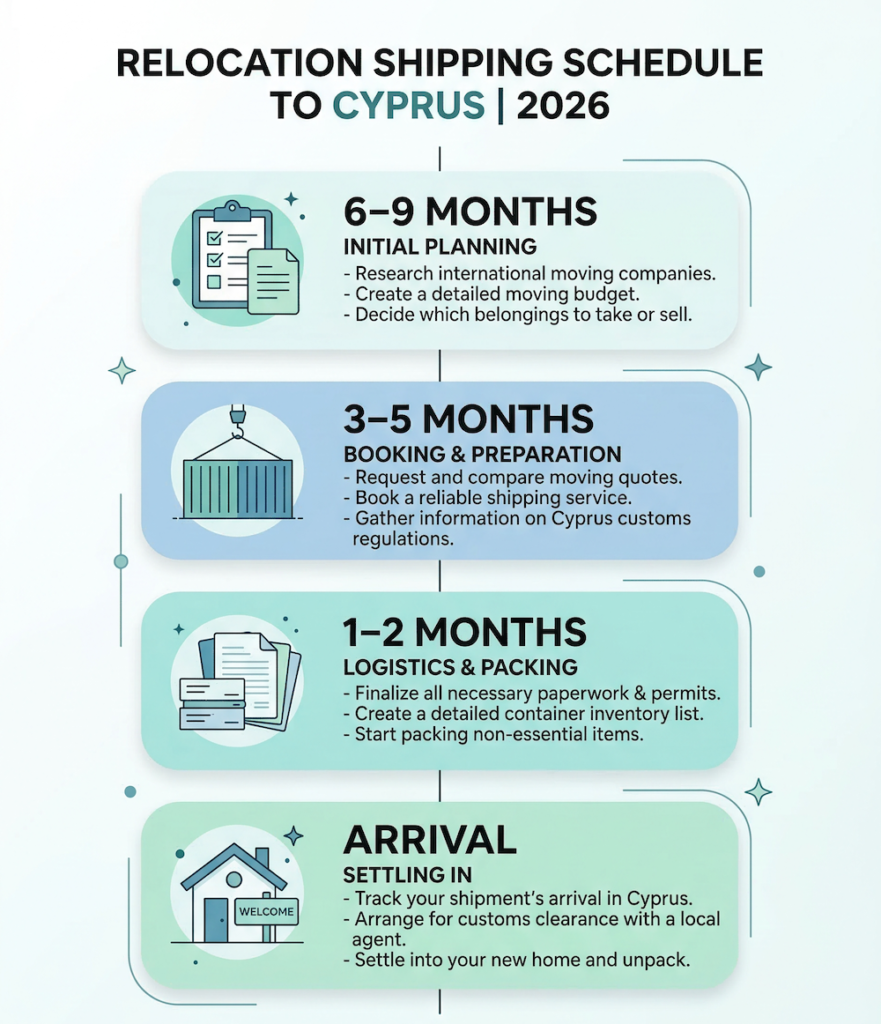
Your moving journey, simplified: The process of shipping belongings to Cyprus is a marathon, not a sprint. We break it down into four manageable phases. Phase 1 (6-9 months before your move) is about foundational research, serious decluttering, and gathering initial quotes. Phase 2 (3-5 months out) involves locking in your international mover and finalizing your inventory. Phase 3 (1-2 months out) is dedicated to meticulous packing and preparing all customs paperwork. Finally, Phase 4 (Arrival) covers customs clearance at the port and the final delivery to your new Cypriot home.
Phase 1 (6-9 Months Out): Research, Decluttering & Initial Quotes
This is your planning and strategy phase. Begin researching visa requirements, potential neighborhoods, and schooling options. This is also the prime time to declutter your home significantly. Once you have a rough idea of your shipment volume, start requesting initial quotes from international movers to build your budget. I always advise starting this early to lock in favorable rates before seasonal price hikes.
Phase 2 (3-5 Months Out): Choosing Your Mover & Finalizing Inventory
With several quotes in hand, it’s time to choose a reliable moving company. Vet them thoroughly by checking accreditations and reviews (more on this below). Once you’ve selected your mover, work with them to create a preliminary inventory list. You should compare at least three detailed, itemized quotes before making a final decision.
Phase 3 (1-2 Months Out): Packing & Finalizing Paperwork
Creating a Detailed Inventory List (Mandatory for Customs)
Your final inventory list is a critical legal document for Cyprus customs. It must be itemized, with each box numbered and its general contents and estimated value listed. For high-value electronics, it’s a good practice to include model and serial numbers. A detailed list prevents customs delays and is essential for any potential insurance claim.
A Guide to Packing Furniture, Electronics, and Fragiles
If you’re doing a partial self-pack, use high-quality materials. Use multiple layers of bubble wrap for fragile items and put them in double-walled boxes. Disassemble large furniture whenever possible, placing all nuts and bolts in a labeled bag taped securely to the main piece. Label every box clearly with its contents and designated room.
Phase 4 (Arrival & Final Mile): Customs Clearance and Home Delivery
What Happens at Limassol/Larnaca Port
Once your container arrives at the port in Limassol or Larnaca, it will be unloaded and held for customs inspection. Your moving company’s local agent will submit all your paperwork. Assuming everything is in order, the clearance process typically takes 1-3 business days. You will need to pay any applicable port fees or taxes at this stage.
Arranging Local Delivery & Unpacking
After clearance, your belongings are loaded onto a smaller truck for delivery to your new home. If you want help with heavy lifting and unpacking, this can usually be arranged with your mover or a local service for around €200-€500. Unpack methodically, starting with essentials like the kitchen and bedrooms, to help you settle in quickly and feel at home. Of course, the part I love helping with most is ensuring you have the perfect place to unpack into. Once your belongings are en route, it’s the ideal time to finalize your housing, whether you plan to rent property in Cyprus for your first year or are ready to buy property in Cyprus and put down permanent roots.
Navigating Cyprus Customs in 2026: Duties and Regulations for Your Belongings
The Key to a Tax-Free Move: Qualifying for “Transfer of Residence” (ToR) Relief
To bring your household goods into the country tax-free, you must qualify for ‘Transfer of Residence’ (ToR) relief. This is available to individuals relocating their primary home to the island. You can review the specific criteria directly on the official Cyprus Customs and Excise Department page. I have personally guided dozens of clients through this paperwork, and successfully securing ToR can save you thousands of euros in potential duties.
Essential Documents Checklist for Customs Clearance
- T2L Document: A declaration proving the EU status of your goods, if shipping from within the EU.
- Form C104A: The Unaccompanied Effects Declaration form for shipments from outside the EU.
- Proof of Residency: Your Alien Registration Card (ARC) or “Yellow Slip.”
- Copy of Your Passport: Photo and details page.
- Detailed Inventory List: In English, with values declared in Euros.
Prohibited & Restricted Items: What Not to Pack
A simple rule: when in doubt, declare it or leave it behind. Prohibited items include firearms, narcotics, and obscene materials. Restricted goods that require special permits include plants, large quantities of alcohol and tobacco, and certain radio-transmitting equipment. Check pet import regulations separately. One client faced significant delays because of unmarked antique sculptures in their shipment—always declare items of high value or cultural significance.
How to Choose the Best International Removals Company for Cyprus
Critical Questions to Ask Potential Movers
- Are you accredited by FIDI, BAR, or other international moving associations?
- Can you provide three recent customer references for moves specifically to Cyprus?
- What does your insurance policy cover, and what is the claims process?
- Who is your partner agent in Cyprus that will handle customs and final delivery?
- Is your quote a binding estimate, or could there be additional charges?
Red Flags: Warning Signs of a Disreputable Company
Vague quotes, pressure for large upfront cash deposits, or a lack of clear insurance details are all major red flags. For removals to Cyprus, I always advise clients to steer clear of any company that isn’t FIDI or BAR accredited; it’s just not worth the risk. Be wary of quotes that are dramatically lower than all others, as they often hide significant fees on the back end.
Get Your Free, Vetted Shipping Quotes
Getting quotes is the next logical step, but it can be time-consuming. To make it easier, I’ve established relationships with several trusted, FIDI-accredited movers who specialize in shipping to the island.
Once you have your quotes, you can focus on the exciting parts of your move. For more honest insights on what it’s really like to settle in, from finding schools to opening a bank account, I share everything on my Cyprus Life & Real Estate Blog.
The “Buy vs. Ship” Dilemma: A 2026 Cost-Benefit Analysis for Furniture & Appliances
Shipping a large item like a sofa or a refrigerator can cost €500-€2,000. Before you pay to move it, check local prices. Major appliance brands are readily available here, and they come with local warranties and EU-standard plugs. When I moved, I shipped core sentimental furniture but bought all major appliances in Cyprus—my calculations showed it saved me over €1,500 and a lot of hassle.
Should You Ship Your Car to Cyprus?
This is a tricky one. If your car is less than six months old or has fewer than 6,000 km, it’s considered “new” and you will pay both VAT and excise duty. The shipping cost itself is €1,000-€3,000. In many cases, it is financially smarter to sell your car at home and buy a new or used one here. Plus, Cypriot roads, especially in older towns, are better suited to smaller, more maneuverable cars.
Critical Mistake to Avoid: Underestimating Cypriot Home & Apartment Dimensions
This is a lesson learned the hard way by many expats. Older Cypriot homes and apartment buildings often have narrower doorways, tighter stairwells, and smaller elevators than you might be used to. Measure your large furniture (and the access points of potential new homes) before you pay to ship it across the world. A client of mine had to resell a beautiful, oversized American-style sofa because it simply would not fit through the door of their new villa. Thinking from a different angle, if your move is also a financial one, a deep dive into the island’s property market is essential. Many of my clients successfully combine their relocation with smart financial planning. You can explore a variety of high-yield assets in our detailed guide to real estate investment in Cyprus.
Frequently Asked Questions (FAQ) about Shipping to Cyprus
How long does sea shipping take to reach Cyprus?
From most European ports, you can expect a transit time of 2-4 weeks. If you’re shipping from further afield, like the USA or Australia, it’s typically 4-6 weeks. Always factor in an extra week for potential port delays, especially during the peak summer season.
Do I have to be physically present in Cyprus for my goods to clear customs?
No, you don’t have to be physically present at the port, but you must appoint a certified customs agent to act on your behalf. My advice? If possible, be in the country. It provides peace of mind and allows you to address any unexpected issues immediately.
Can I track my shipment’s journey?
Absolutely. Any reputable international moving company will provide a tracking number and an online portal or app. This allows you to follow your container’s journey in near real-time, from departure port to its arrival in Limassol or Larnaca.
Is shipping insurance really necessary and what does it cost?
In my 16 years of experience, I consider it non-negotiable. Standard liability from shipping lines is minimal. Proper insurance, typically costing 1-3% of your declared goods’ value, protects you against damage or loss. A client of mine once skipped it to save a few hundred euros and ended up losing thousands when a few boxes were damaged by water. It’s a small price for total peace of mind.
Can I ship my pet with my household goods?
This is a common question, but the answer is a firm no. Pets cannot be shipped inside a container with your household goods due to safety and legal regulations. They must travel separately via specialized pet relocation services, typically by air, with all the necessary veterinary certificates and import permits handled by experts.