
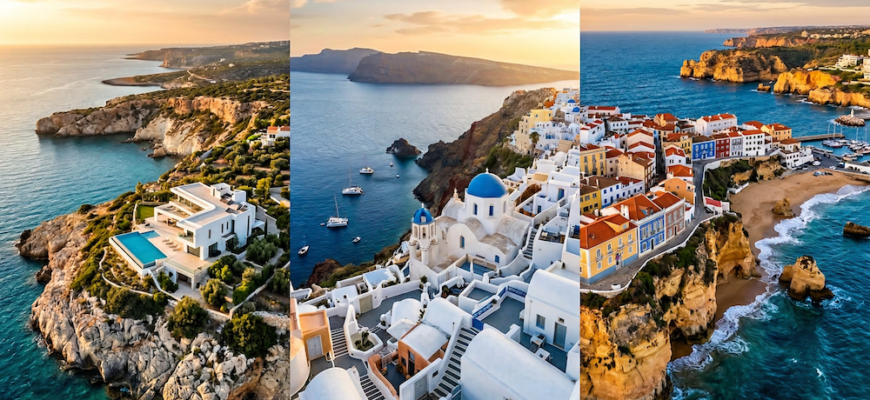
Comparison for 2026: Cyprus, Greece, and Portugal in One Table
When considering a major life change or investment, a frequent question I get is about Cyprus real estate vs Greece or Portugal. For 2026, investors must weigh critical factors like property prices, rental yield, residency programs, taxation rates, overall ROI, and the quality of the residency permit. After living and working in the Cyprus real estate market for over 16 years, I’ve seen firsthand how the island consistently offers a stable and profitable environment. This table is your starting point, a quick snapshot to compare the key metrics before we dive deeper.
| Parameter | Cyprus | Greece | Portugal |
| Residency Program for Investments (2026 Status) | Permanent Residency (PR) via €300,000 property purchase; fast-track (2-3 months), EU-wide access (non-Schengen). | Golden Visa: Thresholds increased to €800,000 in high-demand areas like Athens, €400,000 elsewhere; provides Schengen access. | Golden Visa revamped; direct property route closed, shifted to funds (€500,000 min) or alternative D7/D8 visas for passive income. |
| Average Price per m² (City/Coast) | €3,000-€5,000 (Limassol coast). | €2,500-€4,500 (Athens Riviera). | €3,500-€6,000 (Lisbon/Algarve). |
| Forecasted ROI (Rental + Growth) | 5-8% (strong, year-round tourism-driven rental yield). | 4-6% (tourism-dependent, which can be seasonally volatile). | 4-7% (historically stable, but recent NHR and AL license changes introduce new variables). |
| Key Taxes (Purchase, Ownership, Income) | 5-19% VAT on new builds; 12.5% corporate tax for businesses; no inheritance tax. | 24% VAT; up to 0.7% annual property tax (ENFIA); 22-45% income tax. | 28% capital gains; 0.7-1.5% property tax (IMI); 25-48% income tax (NHR phased out for new residents). |
| Quality of Life (Index) | 75/100 (exceptionally safe, 340+ sunny days, large and welcoming expat community). | 68/100 (rich cultural heritage, but can be bureaucratically challenging for expats). | 80/100 (relaxed, Atlantic coastal lifestyle, very popular with digital nomads). |
Forecast ROI for 2026: Comparing Real Estate Investment Returns
When we break down the numbers based on current market trends and real estate investment ROI statistics, the financial picture becomes clearer. For 2026, the forecast shows Cyprus leading in potential overall returns. This isn’t just about rental income; it’s about the combination of steady rental yield from tourism and consistent capital growth, fueled by ongoing development projects. While Greece and Portugal have strong points, Cyprus presents a more balanced and robust investment case for long-term growth.
Why Investors Compare Cyprus, Greece, and Portugal in 2026
Let’s be honest, as someone who relocated to Cyprus in 2010 and built a life here, I understand completely why the conversation always circles back to these three Mediterranean gems. They all promise a sun-drenched lifestyle, from the azure coasts of Cyprus and Greece to the dramatic Atlantic shoreline of Portugal. In the post-pandemic era, Portugal property investment and opportunities in Cyprus and Greece are tightly linked to residency programs, blending the dream of a Mediterranean home with smart financial returns. Cyprus consistently shines for its EU access and advantageous tax system. Greece lures with its unparalleled cultural depth and full Schengen mobility. Portugal has long been famous for its (now-changing) non-habitual resident scheme. Investors are looking for high ROI from tourism-driven rentals and capital appreciation, but the right choice truly depends on your end goal. I’ve guided hundreds of clients through this decision, often debunking myths like “Greece is always cheaper”—it rarely is once you factor in taxes and transaction complexities. For more of these on-the-ground insights, feel free to browse my Cyprus Life & Real Estate Blog.
Paths to Residency Through Investments in 2026: Comparative Analysis
A residency permit remains a primary motivator for many international investors, offering not just a place to live but legal stability and enhanced mobility. In 2026, the programs in Cyprus, Greece, and Portugal differ significantly in terms of speed, cost, and benefits, directly influencing where you should invest your capital.
Cyprus: Accelerated Permanent Residency (PR) for Investments
Cyprus’s Permanent Residency program is straightforward and, in my experience, one of the most efficient in Europe. It requires a minimum €300,000 investment in new-build real estate, and the permit is typically processed within 2-3 months. The status is perpetual, grants EU-wide travel (though outside the Schengen Area), and is ideal for families or business owners since no physical presence is required after approval. The main advantages are the rapid approval time and the ability to pass the status down to heirs. Investors must simply prove a clean source of funds and visit the island once every two years. Clients I’ve worked with are often amazed at how quickly they can secure this status, unlocking EU benefits without the bureaucratic hurdles seen elsewhere.
Official source: Cyprus Civil Registry and Migration Department (moi.gov.cy).
Greece: New Rules for the Golden Visa
Greece’s Golden Visa program has undergone significant changes. It now requires a minimum investment of €800,000 in prime locations like Athens, Thessaloniki, Mykonos, and Santorini, with the threshold dropping to €400,000 in less popular zones. The key benefit is immediate access to the Schengen Area, and the visa is renewable every five years with family inclusion. On the plus side, you get full EU mobility and strong rental potential backed by a massive tourism industry. The downside, however, involves a lengthy processing time of 6-12 months and increasing bureaucracy amid ongoing economic reforms. The region you choose matters greatly—Athens offers year-round demand, while island properties often face seasonal income dips.
Official source: Greek Ministry of Migration and Asylum (migration.gov.gr).
Portugal: Life After the Golden Visa on Property
In 2023, Portugal ended its popular direct property-for-residency Golden Visa route. The focus has now shifted to alternative paths, such as a €500,000 contribution to investment funds or a €250,000 donation to cultural heritage projects. For those seeking residency through more traditional means, visas like the D7 (for passive income earners) or D8 (for digital nomads) are available, requiring proof of a stable income (starting from around €820/month) but are no longer directly tied to a real estate purchase. This policy change aims to diversify the economy but complicates the journey for those who wanted to tie their residency directly to a home purchase.
Official source: Portuguese Agency for Integration, Migrations and Asylum (AIMA, formerly SEF) (aima.gov.pt).
Arguments in Favor of Cyprus: Key Advantages for Investments in 2026
From my 16 years in the Cyprus real estate industry, I’ve consistently seen investors succeed here due to a powerful combination of tax benefits, a straightforward permanent residency program, high ROI, and an unbeatable lifestyle. Unlike the economic volatility sometimes seen in Greece or the recent policy shifts in Portugal, Cyprus offers a stable and predictable growth environment; property values have shown consistent appreciation, rising steadily in the years leading up to 2026. The island’s safety is a huge draw—it has one of the lowest crime rates in the EU—and the market’s liquidity ensures that assets can be sold efficiently. For families, it is a true haven with excellent English-speaking schools and clean, accessible beaches. Here’s what truly stands out:
- Favorable Tax Regime: A tax haven status bolstered by the Non-Domicile program.
- High Rental Yields: Strong rental demand fueled by both tourism and a growing expat business community.
- Secure Investments: A transparent legal system based on British common law, with strict investor protections.
- Unmatched Lifestyle: A unique blend of Mediterranean tranquility and modern business infrastructure.
If you are exploring a real estate investment in Cyprus, these fundamental factors are what create sustainable, long-term capital appreciation.
Tax Haven of the Mediterranean: Non-Domicile Status and Low Taxes
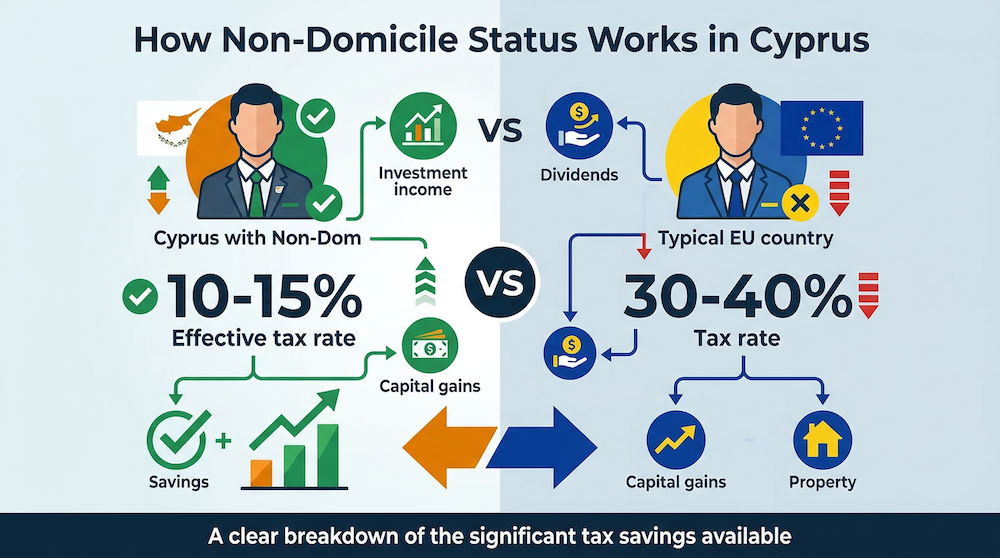
Cyprus’s Non-Domicile (“Non-Dom”) regime is a game-changer for international investors. It exempts foreign-sourced income, such as dividends and interest, from taxation for 17 years. This is complemented by one of the EU’s lowest corporate tax rates at 12.5% and a complete absence of inheritance tax. For a high-net-worth individual, this framework can result in tens of thousands of euros in tax savings annually compared to other European jurisdictions.
Real Estate Market: Stable Growth and High Potential
The Cyprus property market is forecast to experience 5-7% annual growth in 2026, driven by major infrastructure projects like the Limassol and Ayia Napa marinas and Europe’s largest integrated casino resort. This development, combined with a robust tourism sector, ensures reliable rental yields of 4-6%. In my practice, I have seen clients achieve significant returns on their investments over a five-to-seven-year period through a combination of rental income and capital appreciation.
Legal Purity: Importance of Title Deed and Investor Protection
In Cyprus, a Title Deed is the ultimate proof of ownership, confirming that a property is free from liens or other encumbrances. Its availability is non-negotiable for a secure investment. My role often involves guiding clients through a thorough due diligence process, which includes verifying building permits, checking for bank guarantees from the developer, and ensuring all legal requirements are met. This disciplined approach helps clients avoid the title deed issues and legal ambiguities that can sometimes arise in other markets.
Analysis of the Greek Real Estate Market in 2026
The real estate market in Greece for 2026 presents a picture of contrast. On one hand, there are clear opportunities driven by the post-pandemic tourism boom. On the other, investors face economic risks and bureaucratic complexities. Property prices average around €3,000/m² in prime areas, with an expected ROI of 4-6% from rentals. However, its market remains more volatile than that of Cyprus. Post-2023 reforms, which significantly raised the Golden Visa investment thresholds, have cooled demand in certain segments. Islands like Crete and Corfu offer high liquidity due to immense tourist footfall, yet the mainland is often plagued by slow administrative processes. In my direct comparisons of Cyprus vs Greece, Greece is an excellent choice for those who prioritize culture and Schengen access, but Cyprus generally wins on financial stability and ease of transaction.
Influence of Tourism on Returns and Liquidity
With over 30 million tourists visiting annually, Greece experiences a massive spike in demand for short-term rentals, especially on islands like Crete and Corfu, where yields can hit 5-7% during peak season. Properties along the Athens Riviera are also highly liquid and can be sold quickly. The main challenge, however, is managing off-season vacancies, which can significantly impact annual cash flow and require careful financial planning.
Bureaucratic Barriers and Economic Risks
The process of purchasing property in Greece involves notarized deeds, thorough checks at the land registry, and other hurdles that can extend the transaction timeline to several months. A 3% transfer tax is applied to purchases, and the country’s economic history of high public debt still represents a background risk of potential instability or future tax reforms. Engaging experienced local legal support from the very beginning is absolutely essential.
Is It Still Worth Investing in Portuguese Real Estate in 2026?
A Portugal property investment in 2026 is still a viable option, but the landscape has fundamentally changed. Market trends show respectable rental yields of 4-6% on the west coast, and the country still offers a relatively low cost of living. However, the termination of the Non-Habitual Resident (NHR) tax regime for new applicants has removed a major financial incentive. While the economy is projected to grow, new restrictions on short-term rental licenses (Alojamento Local) are limiting income potential in major cities. My take? Portugal excels for lifestyle-focused buyers like retirees, but for pure investors, the returns are diminishing. I’ve personally advised clients who were considering Portugal to pivot to Cyprus for a more favorable ROI and a clearer path to residency through real estate.
End of NHR Regime and AL Licenses: What Changed for Investors
The phasing out of the NHR program means new residents will now face Portugal’s standard income tax rates of 25-48%, eliminating the attractive 10-year flat tax benefit. Furthermore, new AL licenses for short-term rentals are now capped or banned in cities like Lisbon and Porto, which could reduce potential rental yields by 2-3% in these high-demand areas, pushing investors to look elsewhere.
Where the Focus Has Shifted: From Algarve to Silver Coast and Islands
With the Algarve becoming saturated and expensive, savvy investors are now exploring other locations. The Silver Coast offers more affordable properties, often below €3,000/m², with stunning ocean views. The autonomous region of Madeira also presents a compelling alternative, as it continues to offer special tax incentives. These areas can still generate rental yields of around 5% and offer a more authentic, less crowded experience.
Quality of Life and Relocation: Comparison for Expats
Infrastructure: Healthcare, Education, and Transport
Cyprus excels with its high-quality private healthcare, with excellent facilities like the American Medical Center, and its comprehensive national healthcare system (GESY). International schools are plentiful, with annual fees around €7,000-€12,000, and airports in Larnaca and Paphos offer direct flights across Europe and the Middle East. Greece has an affordable public healthcare system, but it can involve long waits. Portugal boasts efficient transport hubs, especially Lisbon’s airport, but the quality of public education and healthcare can vary significantly outside of major urban centers.
Integration and Community: Where Is It Easier to Adapt?
English is spoken almost universally in Cyprus’s business and social hubs, which makes integration seamless for many expats, including a large and well-established community of Russian speakers. In Greece, while there are strong expat communities, a basic knowledge of Greek is often necessary for daily life outside of tourist zones. Portugal is famous for its friendly and welcoming vibe, and English is widely spoken in cities like Lisbon and Porto, helping digital nomads and new arrivals feel at home quickly.
Verdict from Oliver Bennett: Why Cyprus Is the #1 Choice for Investors
After 16 years of living, working, and raising a family on this island, my recommendation is clear and confident. For an investor seeking that rare combination of high financial returns, legal security, and an exceptional quality of life, Cyprus in 2026 remains unmatched. Its stable market, unparalleled tax advantages, and efficient residency program deliver tangible, long-term value without the economic risks of Greece or the recent policy uncertainties of Portugal.
“I’ve navigated European property markets for over a decade and a half, and my conviction remains firm: for an investor’s peace of mind and portfolio growth, Cyprus offers a synergy of stability, profitability, and lifestyle that is simply in a class of its own.” – Oliver Bennett, Cyprus Real Estate Expert
Final Verdict: Which Country Suits You Best?
Your ideal country depends entirely on your personal goals. Based on the many client cases I’ve handled over the years, here is my tailored conclusion.
For the Investor Focused on Multiplying Capital: Cyprus
With the best tax conditions, a stable market delivering 5-8% ROI, and a clear pipeline of growth from new developments, Cyprus offers the most secure environment for capital appreciation.
For the Family with Children Planning to Relocate: Cyprus or Portugal (Silver Coast)
Cyprus provides exceptional safety, top-tier international schools, and an easy environment for doing business. Portugal offers a distinct European culture by the ocean and can be more affordable in areas like the Silver Coast.
For the Digital Nomad or Retiree: Greece or Portugal
These countries often provide a lower cost of living in specific regions, rich cultural experiences, and flexible visa options (like the D7/D8) that are perfectly suited for a more nomadic or relaxed lifestyle without a large capital outlay.
Find Your Ideal Investment Property in Cyprus
Ready to see what your real estate investment in Cyprus could look like? You can start by browsing some prime examples of Cyprus real estate for sale showcased by my trusted partners at DOM. When you’re ready to talk specifics, contact me for a free, no-obligation consultation. I’ll share personalized options based on my 16+ years of on-the-ground experience. Let’s find your perfect high-yield property on this beautiful island.