- Calculate Your 2026 Solar Savings: The Financial Case for Going Green
- Harnessing the Sun: A Deep Dive into Solar Energy for Your Cyprus Home
- The 2026 Solar Technology Spectrum: What to Install
- Photovoltaic (PV) Panels: Generating Your Own Electricity
- Solar Thermal Systems: Free Hot Water from the Sun
- Net Metering vs. Battery Storage: Choosing Your 2026 Energy Model
- The Installation Process Demystified: From Audit to Going Live
- The Decision Point: Build New or Retrofit an Existing Property in Cyprus?
- Building a New Eco-Home: Costs, Timelines, and Advantages
- Retrofitting for Sustainability: A Practical Guide for Older Homes
- Beyond Solar: The Pillars of a Truly Sustainable Cypriot Home
- Foundation of Efficiency: Insulation, Windows, and Smart Systems
- Water Conservation Masterclass for a Dry Climate
- Rainwater Harvesting & Greywater Recycling
- Low-Water Landscaping (Xeriscaping)
- The Positive Environmental Impact of Your Home (2026 Data)
- The Financial Blueprint: 2026 Costs, Grants, and ROI
- Cost vs. ROI Projection Table: Your 2026 Eco-Home Investment
- Full Breakdown of Available 2026 Government Grants & Subsidies
- Legal & Residency: Navigating the Paperwork for Your Green Home
- 2026 Green Hotspots: Where to Find Sustainable Communities and Builders in Cyprus
- City-by-City Green Report: Initiatives in Paphos, Limassol, Nicosia
- How to Vet and Select an Eco-Conscious Builder or Architect
- Your Action Checklist: From Dream to Reality
- Find Your Ideal Sustainable Home in Cyprus
- Frequently Asked Questions (FAQ)
I’ve called Cyprus home since 2010, helping families and investors not just find houses, but build lives here. In my 16 years navigating this market, I’ve watched the gradual shift toward sustainability become a full-blown movement. It’s driven by tangible realities: electricity tariffs that have everyone watching their meters, palpable climate challenges, and clear EU directives demanding lower emissions. For years, going green was a nice-to-have. In 2026, it’s a strategic necessity. Economic pressures make generating your own solar energy a smart financial move. Moreover, EU incentives like the Green Deal are now mature, creating a perfect storm that turns future-proof sustainable homes in Cyprus into high-return investments. If you’re considering this path, this year marks the defining convergence of advanced technology, financial sense, and a surge in buyer demand for an eco-friendly lifestyle. This isn’t just about a feel-good choice anymore; it’s about building tangible wealth with a property designed for the future.
“After 16 years here, I’ve never seen a stronger alignment of financial incentives, technological maturity, and buyer demand for sustainable homes. 2026 isn’t just a good time to invest; it’s the defining moment.”
— Oliver Bennett, Cyprus Real Estate Expert
Calculate Your 2026 Solar Savings: The Financial Case for Going Green
Making the switch to solar energy in Cyprus delivers two major financial wins. First, you drastically reduce your utility bills by harnessing our island’s abundant sunshine. My experience shows that an average household can cut its annual electricity costs by a substantial 50-70%. Second, properties equipped with green features attract what the market calls a “Green Premium.” In the 2026 market, I’ve seen this add a solid 10-15% to a property’s resale value, simply because savvy buyers are actively seeking out homes with long-term energy efficiency. These dual benefits ensure your investment in solar panels pays for itself surprisingly quickly, with a full return on investment often realized within just 5-7 years through significant electricity savings and property appreciation.
Harnessing the Sun: A Deep Dive into Solar Energy for Your Cyprus Home
With over 300 days of brilliant sunshine a year, harnessing solar energy in Cyprus is less of an option and more of a non-negotiable for modern living. It effectively transforms your home into a self-sufficient power source, drastically reducing your reliance on the national grid and shielding you from volatile energy prices. As a realtor who has personally overseen the integration of these systems into dozens of properties, I always recommend it as the cornerstone of any renewable energy strategy for a 2026 investment. The benefits are clear: significantly lower bills, greater energy independence, and a substantially reduced environmental impact, making it an essential component for any modern home on the island.
The 2026 Solar Technology Spectrum: What to Install
Photovoltaic (PV) Panels: Generating Your Own Electricity
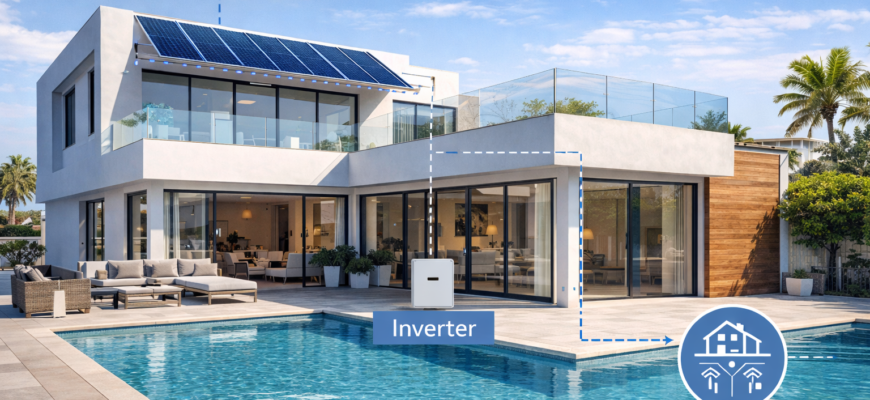
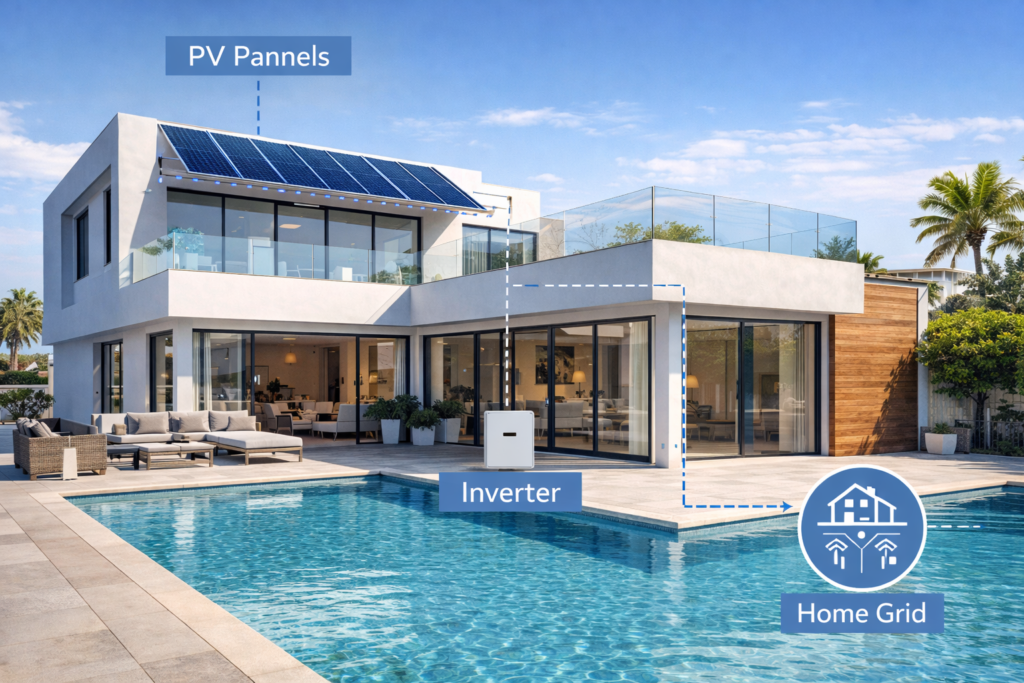
Photovoltaic (PV) solar panels convert direct sunlight into usable electricity through silicon cells, a technology perfectly suited for Cyprus’s hot climate where modern panels maintain high performance. For a typical 200m² family home, a 5-10kW system is usually sufficient to cover the majority of energy needs. In my experience, brands like SunPower or JA Solar are excellent choices as they are known for their resilience in high-heat conditions, consistently delivering impressive 20-22% energy efficiency rates even during the peak of summer.
Solar Thermal Systems: Free Hot Water from the Sun
Solar thermal systems use collectors on your roof to heat water directly from the sun’s rays, a brilliantly simple solution that can save you 60-80% on water heating costs. In a place like Cyprus where hot water is in demand year-round, this is a huge win. These systems, whether using evacuated tube or flat-plate models, integrate smoothly with existing boilers, representing a straightforward yet highly effective upgrade toward an eco-friendly lifestyle.
Net Metering vs. Battery Storage: Choosing Your 2026 Energy Model
Net metering allows you to sell any excess electricity your panels generate back to the grid for credits, while battery storage lets you keep that power for your own use, especially during power outages, offering complete energy independence. For budget-conscious homeowners, my advice is often to start with net metering due to its lower upfront cost, though it does keep you tied to the grid. For those in more remote areas or who prioritize self-sufficiency, smart home technology like battery storage offers peace of mind and potentially higher long-term savings, particularly during blackouts.
| Feature | Upfront Cost | Long-term Savings | Energy Independence | Grid Dependency | Best For |
| Net Metering | Lower (€5,000-10,000) | High via grid credits | Moderate | High | Budget-conscious owners |
| Battery Storage | Higher (€10,000-20,000) | Higher with self-use | High | Low | Off-grid or outage-prone goals |
The Installation Process Demystified: From Audit to Going Live
Getting a solar system up and running isn’t as complex as it sounds. Here’s the process I walk my clients through: First, an initial energy audit is conducted to analyze your home’s unique consumption patterns and confirm your roof’s suitability. Next, a certified installer designs the optimal system and provides a detailed quote. After you approve, they handle the permitting process with local authorities, which typically takes 2-4 weeks in Cyprus. The physical installation and grid connection are surprisingly fast, usually completed in just 1-2 days for a standard residential setup. Finally, the system is commissioned, which involves testing to ensure everything operates perfectly, and you’re set up with monitoring apps to track your energy production in real-time.
The Decision Point: Build New or Retrofit an Existing Property in Cyprus?
One of the biggest questions I get from clients is whether to build a new sustainable home from scratch or upgrade an existing one. The right answer really depends on your timeline, budget, and vision. A new build offers a blank canvas for perfect integration of every green feature, while a retrofit allows you to bring modern efficiency to an older property, often preserving that unique Cyprus charm.
Building a New Eco-Home: Costs, Timelines, and Advantages
Constructing a new eco-home allows for a holistic approach to green building. You can orient the house for maximum sun exposure, embed solar systems and insulation seamlessly, and meet the very latest 2026 EU building codes from day one. Based on current figures, expect costs around €2,500-€3,500 per square meter, with a construction timeline of 6-12 months. The key advantages are achieving peak energy efficiency without compromise and avoiding the hassles of future retrofitting. These homes are designed to be sustainable from their very foundation.
Retrofitting for Sustainability: A Practical Guide for Older Homes
For Cyprus’s charming traditional stone houses, the focus should be on high-impact upgrades. I always advise clients to prioritize high-grade insulation, modern energy-efficient windows, and solar add-ons to dramatically boost the property’s energy rating. I’ve personally guided clients through retrofits that have successfully slashed their utility bills by over 40%, proving it’s entirely feasible to create a modern, efficient home without sacrificing its heritage. A sustainable upgrade is about more than just solar panels; it’s a whole-home approach.
Beyond Solar: The Pillars of a Truly Sustainable Cypriot Home
A truly sustainable home in Cyprus goes beyond just generating power. It’s about a comprehensive strategy that includes radical energy efficiency, advanced smart home technology, and tackling a major local environmental challenge: water scarcity, through dedicated conservation and recycling practices.
Foundation of Efficiency: Insulation, Windows, and Smart Systems
In Cyprus’s intense summer heat, high-performance insulation (like extruded polystyrene foam boards) is your first line of defense, capable of reducing your cooling needs by up to 30%. Paired with modern double- or triple-glazed windows that block solar heat gain, you create a thermal shield for your home. To take it further, smart home technology like automated thermostats and lighting systems can learn your habits and optimize energy consumption, often reducing overall energy use by an additional 20%.
Water Conservation Masterclass for a Dry Climate
The reality of living on an island is that water scarcity is a pressing issue, with droughts becoming more common. This makes water conservation and recycling not just eco-friendly but essential for a self-reliant home.
Rainwater Harvesting & Greywater Recycling
A simple system to collect roof runoff into storage tanks can supply all your garden irrigation needs, saving up to 50% on municipal water bills. Going a step further, greywater systems capture and filter water from showers and sinks for non-potable uses like watering plants, further reducing waste and your home’s environmental impact.
Low-Water Landscaping (Xeriscaping)
Xeriscaping is the practice of designing a landscape that requires little to no irrigation. By using beautiful, drought-tolerant native plants, gravel, and mulch instead of a thirsty lawn, you can cut your landscape water consumption by as much as 75%, even in our driest months.
The Positive Environmental Impact of Your Home (2026 Data)
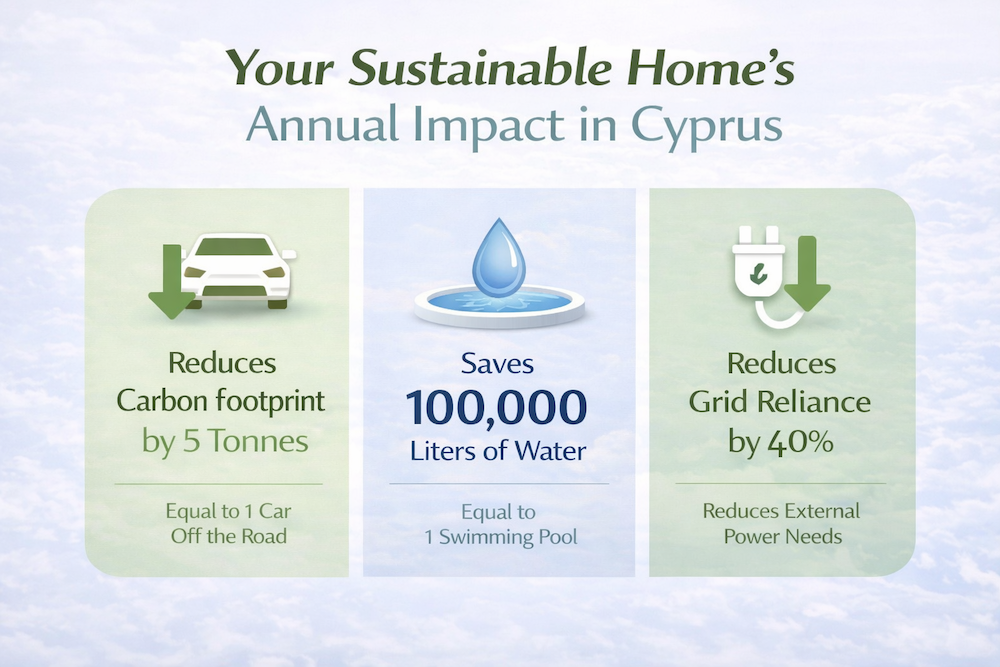
The collective effect of individual actions is powerful. A single sustainable home in Cyprus can reduce its carbon emissions by approximately 5 tonnes annually—the equivalent of taking one gasoline-powered car completely off the road. It can also save around 100,000 liters of water each year, enough to fill a small swimming pool, and reduce its reliance on the national grid by over 40%. These individual efforts directly contribute to our national carbon reduction goals and help manage precious resources.
The Financial Blueprint: 2026 Costs, Grants, and ROI
Cost vs. ROI Projection Table: Your 2026 Eco-Home Investment
| Upgrade | Estimated Upfront Investment (€) | Available 2026 Grant (€) | Net Cost (€) | Annual Savings (€) | Payback Period (Years) |
| PV System (5kW) | 10,000 | 3,000 | 7,000 | 1,500 | 4.7 |
| Solar Thermal | 4,000 | 1,000 | 3,000 | 800 | 3.8 |
| High-Performance Windows | 8,000 | 2,000 | 6,000 | 600 | 10 |
| Roof Insulation | 5,000 | 1,500 | 3,500 | 700 | 5 |
Full Breakdown of Available 2026 Government Grants & Subsidies
The government of Cyprus provides strong incentives. You can get grants of up to €3,000 for installing solar PV systems through the national Renewable Energy Scheme, and an additional €1,000-€2,000 for energy efficiency upgrades (like insulation and windows) via the Energy Efficiency Fund. A key point I always clarify for my clients is that non-EU citizens absolutely qualify for these grants, provided they legally own the property. The application process is managed through the Ministry, and I can guide you through it. All information is sourced directly from the Cyprus Ministry of Energy, Commerce, and Industry and is accurate for 2026 planning.
Legal & Residency: Navigating the Paperwork for Your Green Home
The process to buy property in Cyprus is straightforward when handled correctly. It begins with thorough title deed checks and drafting a sale contract with a qualified lawyer, a process that typically takes 1-3 months. For residency, obtaining the Permanent Residency permit (often called the Yellow Slip for EU citizens) requires proof of stable income and health insurance. Interestingly, a significant real estate investment in Cyprus, especially in a high-value sustainable property of €300,000 or more, can substantially strengthen your residency application under certain investment programs. In my experience, I’ve helped clients leverage their forward-thinking green property investments to demonstrate a strong commitment to the island, which aligns perfectly with EU sustainability goals and is viewed favorably by authorities.
2026 Green Hotspots: Where to Find Sustainable Communities and Builders in Cyprus
City-by-City Green Report: Initiatives in Paphos, Limassol, Nicosia
Paphos is a clear leader in green initiatives, actively promoting solar-friendly building permits and featuring several new eco-developments. Limassol is heavily investing in smart city infrastructure to improve energy efficiency on a municipal level. Nicosia, as the capital, is pushing for large-scale urban green retrofits to modernize its existing building stock.
How to Vet and Select an Eco-Conscious Builder or Architect
When choosing a partner for your green home, ask pointed questions. Request to see the energy performance certificates (EPC) of their past projects. Scrutinize their portfolios for genuine green building designs, not just superficial additions. Always verify their qualifications and look for engineers with specific EPC certifications. For those looking for a head start, our strategic partners at DOM — Leading Real Estate Agency in Cyprus maintain a list of vetted eco-conscious professionals. You can also find broader tips and market analysis on our Cyprus Life & Real Estate Blog.
Your Action Checklist: From Dream to Reality
- Define Your Budget & Financial Goals: Know what you want to invest and what returns you expect.
- Use the Savings Calculator: Get a realistic projection of your potential ROI.
- Decide: Build New or Retrofit?: Choose the path that fits your vision and resources.
- Research Government Grants: Identify all the subsidies you qualify for to reduce upfront costs.
- Explore Green Hotspots & Vetted Builders: Find the right location and the right team.
- Schedule a Consultation: Let’s sit down and discuss your project in detail.
Find Your Ideal Sustainable Home in Cyprus
Ready to turn your vision of a green home into a reality? If you need to find the right property and want to discuss sustainable homes with a real estate expert who has been on the ground here for over 16 years, I’m here to help. Let’s consult on your project.
Frequently Asked Questions (FAQ)
How much can I realistically save on my electricity bill with a modern solar system?
Based on 2026 data from the Cyprus Energy Agency, a typical 5kW system for an average family home provides electricity savings between €1,200 and €1,800 annually. This depends on your consumption habits and the system’s efficiency.
Are government grants for eco-upgrades available to non-EU citizens buying property in Cyprus?
Yes, absolutely. The grants are tied to the property, not the owner’s nationality. As long as you legally own the property and the project meets the technical criteria of the government scheme, you are eligible to apply and buy property in Cyprus with these benefits.
What is the typical maintenance for solar panels in the dusty Cyprus climate?
It’s a great question, as dust can affect performance. I recommend cleaning the solar panels 2 to 4 times per year to maintain peak energy efficiency. You can do it yourself or hire a professional service, which typically costs between €100 and €200 annually. It’s a small investment to protect a big one.
Will investing in green features guarantee a higher resale price for my property in 2026?
While no investment is ever 100% guaranteed, the market trend is overwhelmingly positive. Buyer demand for lower running costs and a smaller environmental impact is stronger than ever.
Is building a new eco-friendly house significantly more expensive than a standard build in 2026?
A new eco-friendly house built with green building principles typically adds 10-20% to the initial construction cost, which translates to about €300-€500 extra per square meter. However, this upfront cost is significantly offset by government grants, immediate and long-term electricity savings, and a higher final property value.